Ask a struggling tenth grader to read disagreement and you will usually see one of two things: a stall at the first syllable followed by a shape-based guess ("disappointment?"), or a flat refusal dressed up as indifference. What you almost never see is a student who knows the word is solvable and has a procedure for solving it. That procedure is what this article teaches.
There is an older approach to this problem, and it is worth naming why we are not using it. The rule-based approach teaches six syllable types, a dozen division principles, and the exceptions to each, and then asks students to apply the full taxonomy to every long word they meet. It tests well on its own worksheet and dies mid-paragraph in a history textbook, because no fourteen-year-old is going to run a classification scheme in the middle of a sentence about the Missouri Compromise. The Flexible Strategy, developed by Archer, Gleason, and Vachon for the REWARDS program (2006) and presented in the CORE Teaching Reading Sourcebook, takes the opposite bet: give students one fast, forgiving procedure and teach them to adjust on the fly.
The strategy rests on two facts about English, and it is worth saying them to students plainly, because they make long words feel beatable:
- Most long words contain at least one prefix or suffix. Peel those off and the hard part shrinks, often dramatically.
- Every syllable contains exactly one vowel sound. Count the vowel sounds and you know how many parts you are dealing with before you say anything.
The goal, and this is the part that makes the strategy flexible rather than rule-bound, is a close approximation the student can adjust into a real word. Not a dictionary-perfect split. Not a labeled diagram. A pronunciation close enough that the student's own oral vocabulary can finish the job.
This article assumes you have already confirmed the student has a decoding gap rather than a vocabulary or comprehension gap. If you have not, start with the companion guide, Phonics Intervention for Middle and High School, which covers the diagnosis question and walks through three checks you can run in ten minutes.
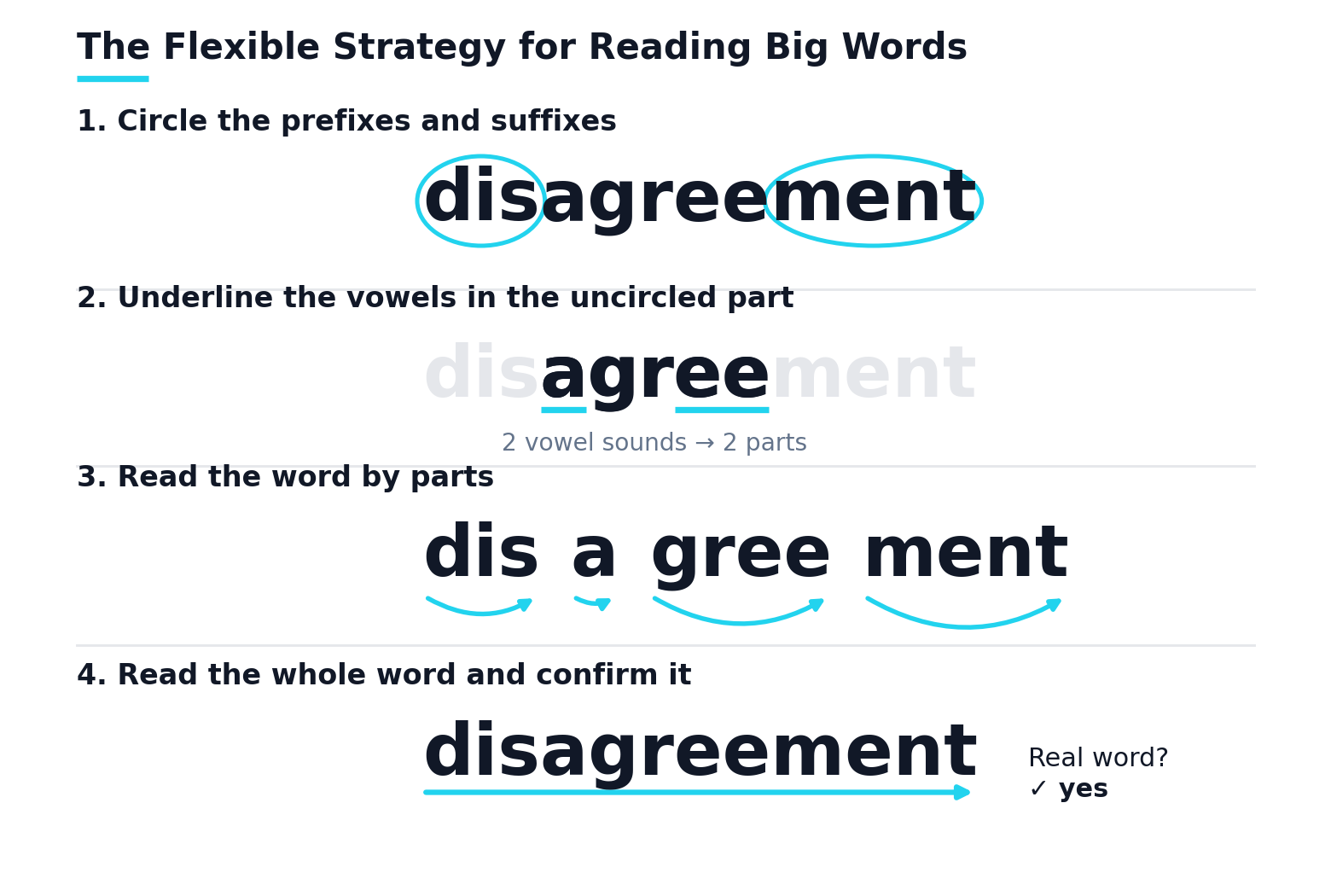
The four steps at a glance
- Circle the prefixes and suffixes.
- Underline the vowels in the uncircled part.
- Read the word by parts.
- Read the whole word and confirm it.
That is the entire strategy. Each step gets its own section below, with the same anchor word carried all the way through so you can see exactly how disagreement moves from an intimidating twelve-letter block to a solved word.
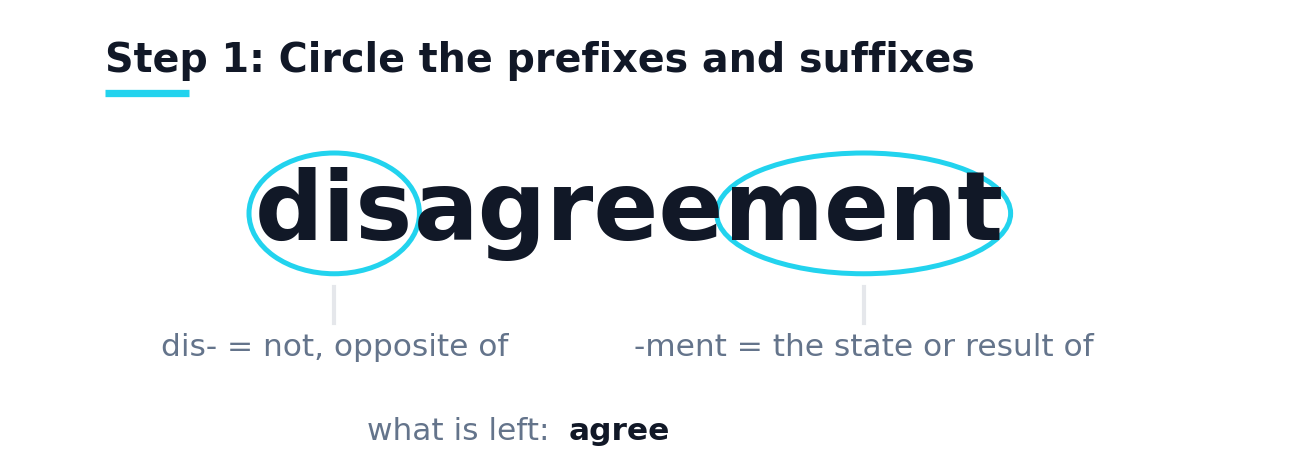
Step 1: Circle the prefixes and suffixes
Affixes come first because they are the biggest single simplification available. Disagreement is twelve letters and four syllables. Circle dis- at the front and -ment at the end and the student is suddenly looking at agree: five letters, two syllables, and a word many students can nearly read on sight. The step is not decorative. It converts a hard problem into a medium one before any decoding begins.
Model the move exactly: look at the front of the word first, then the back. Say what you see. "I see dis- at the beginning. I circle it. I see -ment at the end. I circle it. What is left is agree." Students then do the same with a pencil on paper or a marker on a whiteboard. The physical circling matters in the early weeks; it will fade later, and the fading has its own section below.
The prerequisite: affix recognition
The strategy assumes students can spot high-frequency affixes on sight, and that skill is taught before the strategy, not during it. The good news is that the list is short and the payoff is enormous: a small set of prefixes and suffixes accounts for the overwhelming majority of affixed words students will meet. Teach these to automaticity first, a few at a time, with meanings attached:
| Prefixes | Meaning | Suffixes | Meaning |
|---|---|---|---|
| un- | not | -s, -es | plural |
| re- | again | -ed | past |
| in-, im-, dis- | not, opposite | -ing | ongoing |
| pre- | before | -ly | in that way |
| mis- | wrongly | -er, -or | one who |
| sub- | under | -tion, -sion | act or state of |
| inter- | between | -able, -ible | can be |
| over- | too much | -ment | state or result of |
| de- | down, away | -ness | state of being |
| non- | not | -ful, -less | with, without |
Two cautions for this step. First, teach students that a letter string is only a prefix if removing it leaves a real base: re- in return is a prefix, but the re in read is not, and checking for a surviving base is the test. Second, when students circle something that is not actually an affix, treat it lightly; the whole-word confirmation in Step 4 catches the error, which is one of the reasons the strategy is forgiving.
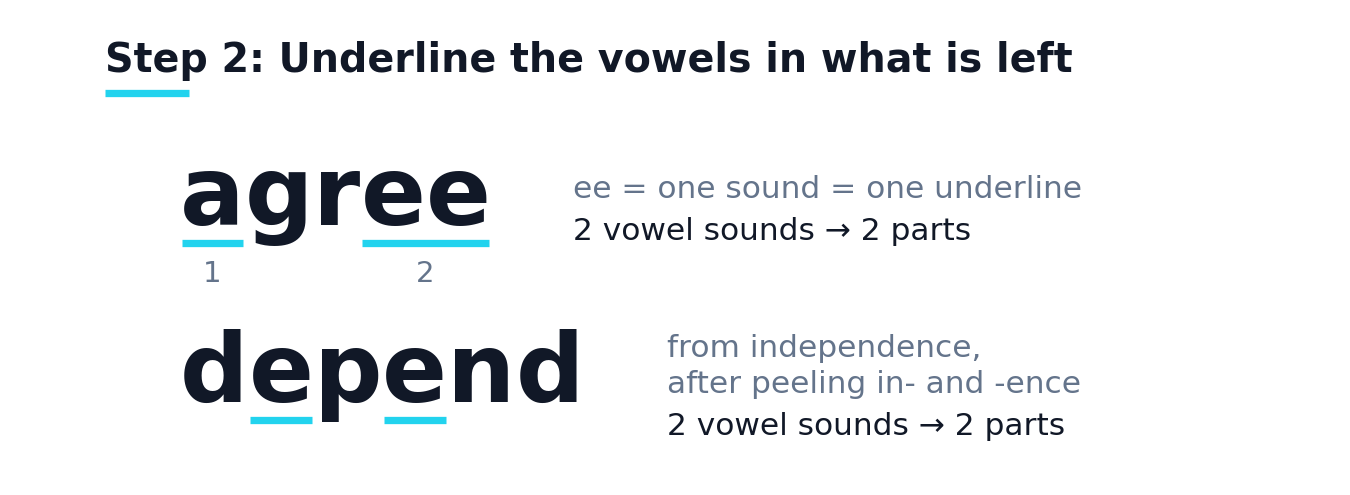
Step 2: Underline the vowels in what is left
With the affixes circled, the student looks only at the uncircled part and underlines every vowel or vowel team. In agree, that is the a and the ee, and here is the first teaching point: ee gets one underline, not two, because the two letters make one sound. One vowel sound per part is the rule the whole step runs on, so vowel teams, silent e, and r-controlled vowels each count as a single underline.
Why this step earns its place: it tells the student the size of the job before they attempt it. Two underlines in agree means two parts, full stop. The student is no longer facing an undifferentiated string of letters; they are facing exactly two chunks, and they know it in advance. For a reader whose history with long words is mostly ambush, that predictability changes the emotional experience of the task as much as the cognitive one.
Model it the same way every time: "Now I look only at what is not circled. I see a. I underline it. I see e-e together; that is one sound, so one underline. Two vowel sounds. Two parts."
The prerequisite here is that students can identify vowels and know the common vowel teams on sight (ai, ea, ee, oa, igh, ay, oi, ou). Most students placed in a decoding intervention by a proper diagnosis already have this, shakily; the underlining step itself firms it up through sheer repetition.
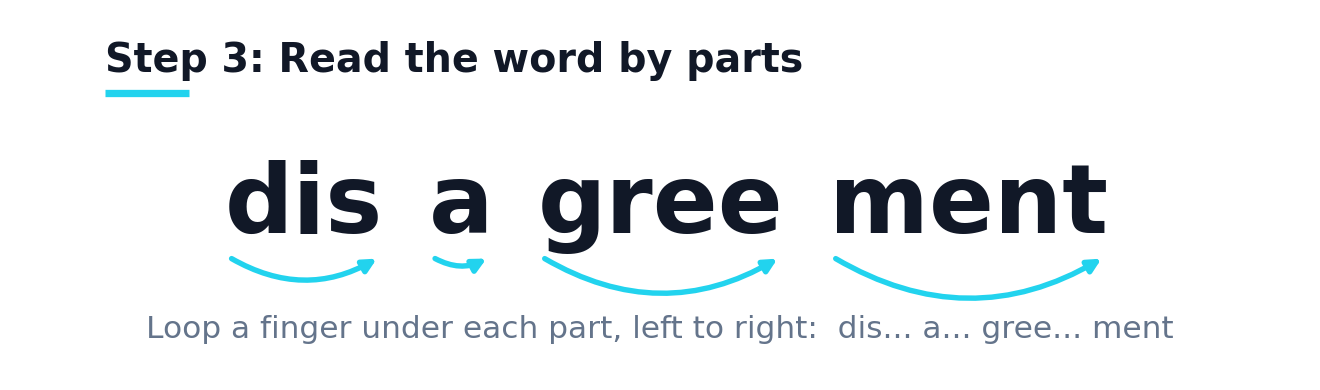
Step 3: Read the word by parts
Now the student breaks the uncircled part into chunks, one vowel sound per chunk, and reads every part of the word in order, left to right: the front affix, the base chunks, the end affix. For our anchor word: dis... a... gree... ment.
The physical move that carries this step is the loop. As each part is read, the teacher (and then the student) sweeps a finger under it in a small arc, left to right, part by part. The loop does two jobs: it forces strict left-to-right attention, which blocks the shape-guessing habit, and it makes the chunking visible, so you can see exactly where a student's attempt breaks down. No part gets skipped, and no one jumps from the first chunk to a whole-word guess.
Two teaching points inside this step:
- The split does not need to match the dictionary. A student who chunks depend as dep-end instead of de-pend has not made an error; they have made a draft. If the parts are pronounceable and the student can blend them into the real word, the split did its job. Say this to students explicitly. It removes the fear of being wrong at a step where "wrong" barely exists.
- One part per vowel sound, always. The most common failure here is treating a two-syllable base as one lump (agree read as a single mashed attempt). The underlines from Step 2 are the fix: two underlines, two parts, no exceptions.
Step 4: Read the whole word and confirm it
The student sweeps a finger under the entire word, reads it as one word, and asks the question that gives the strategy its name: is that a real word I know? For disagreement, the parts blend cleanly and the answer comes back yes on the first try. For many words, it does not, and that is where the flex move lives.
The flex move: Try it, Check it, Flex it
English spelling is reliable but not perfectly predictable, and the unpredictability concentrates in exactly the words this strategy targets: long words, where unstressed vowels collapse into schwa (the lazy "uh" sound) and stress can land in more than one place. A first attempt at magnetic often comes out MAG-net-ic. A first attempt at proclamation often comes out pro-CLAM-ation. Neither attempt is a failure. Each is a draft, one adjustment away from the word.
So teach the confirmation as a loop, not a verdict:
- Try it. Blend the parts and say the whole word.
- Check it. Is that a real word I know? If yes, done.
- Flex it. If no, change one thing and go back to Check it: try the other sound for a vowel (long to short, short to long, or to schwa), or move the stress to a different part.
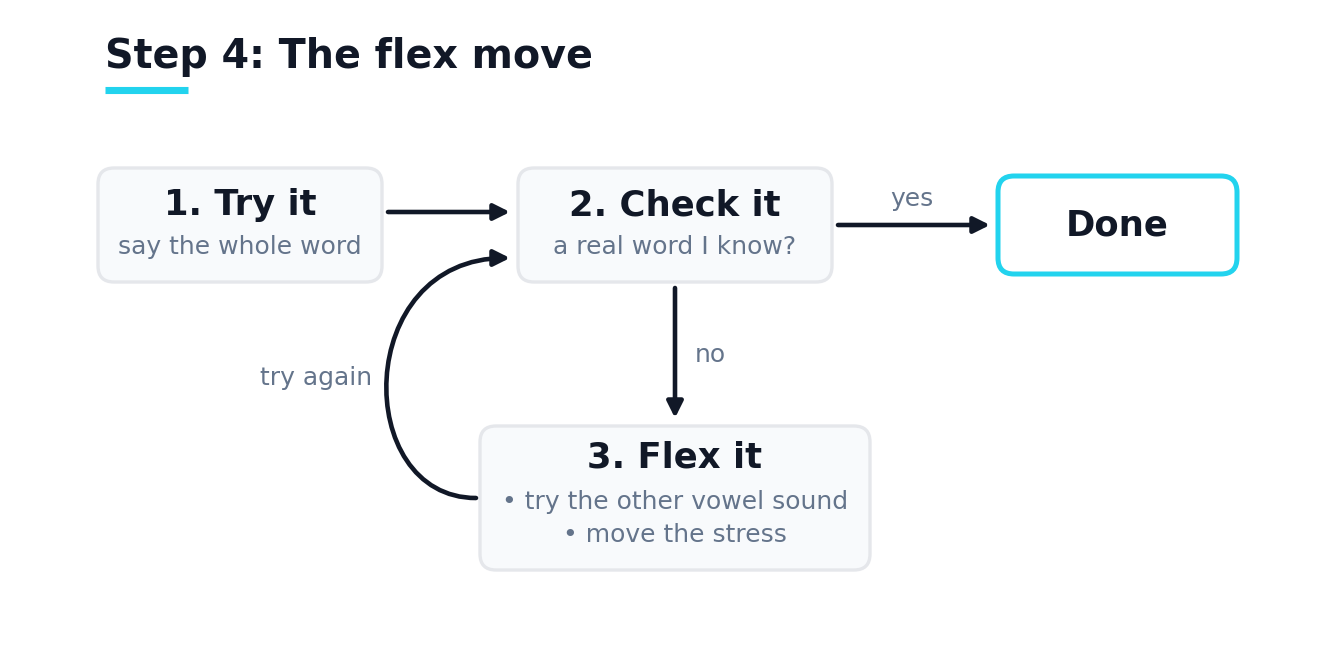
Two things make the flex teachable rather than mystical. First, the student's own oral vocabulary is the answer key. The flex only resolves when the attempt lands on a word the student has heard, which is why the strategy produces a close approximation and lets the ear finish the job. Second, the flex menu is short: vowel sound or stress. Students are not searching an infinite space; they are trying two levers. Name the levers, model using them one at a time, and narrate the moment of recognition every time: "pro-CLAM-ation... hmm, not a word I know. Flex the stress: proc-la-MA-tion... proclamation. There it is."
That moment, the attempt snapping into a known word, is the payoff students need to experience early and often. It is the difference between decoding as rule-following and decoding as problem-solving, and it is the reason a student will keep using the strategy when nobody is watching.
How to teach it: model, guide, release
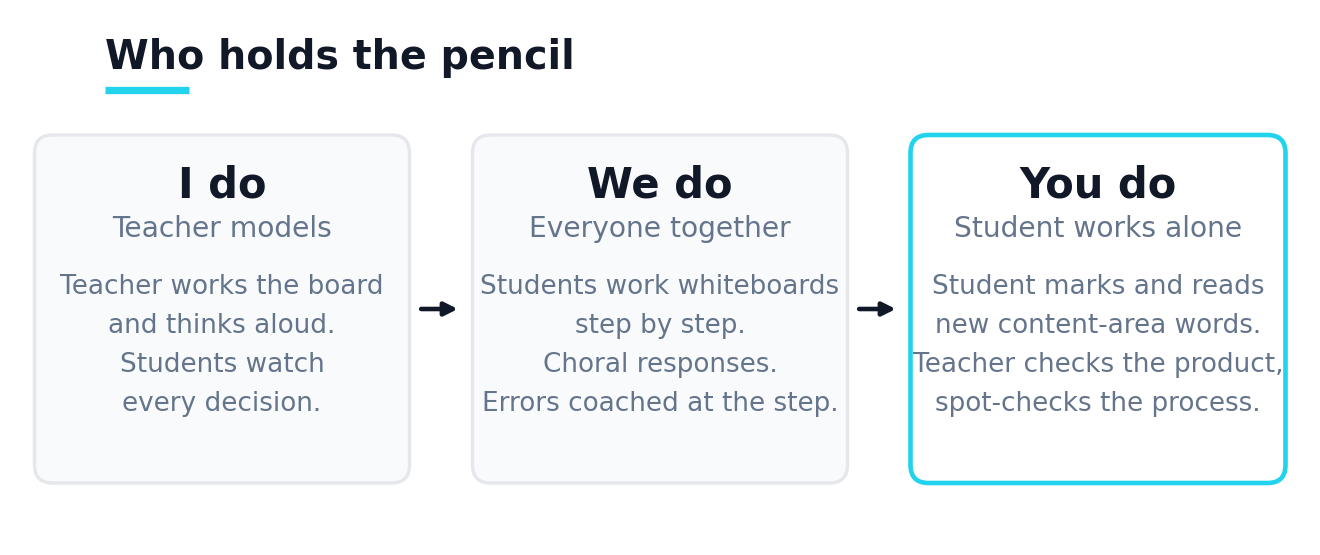
The strategy is learned the way any procedure is learned: the teacher does it while students watch, everyone does it together, then students do it alone while the teacher checks. Plan on several sessions at each phase rather than one, and move forward based on what students can actually do, not on the calendar.
I do: the think-aloud model
Model on the board with a think-aloud that makes every invisible decision audible. Here is a full script on disagreement; use it word for word if you like, then vary the words daily:
"Watch how I read this word. First, I look for prefixes and suffixes. I check the front: I see dis-. I know dis-; it means not, or the opposite of. I circle it. I check the end: I see -ment. I circle that too. Now I only have to figure out the part that is left: a-g-r-e-e.
"Next, vowels in the part that is left. I see a. I underline it. I see two e's together; that is one sound, so one underline. Two vowel sounds means two parts.
"Now I read it by parts." [Loop a finger under each part as you say it.] "Dis... a... gree... ment.
"Last step: the whole word." [Sweep under the full word.] "Disagreement. Is that a real word I know? Yes. A disagreement is when people do not agree, and look, the word even tells me that: dis- means not, agree, -ment makes it a thing. Disagreement."
Model at least three words per session in the early days, including one where the first attempt fails and you flex it out loud. Students need to see the expert be wrong on the first try and fix it calmly; that single demonstration does more for their willingness to attempt than any pep talk.
We do: whiteboards and choral work
Students work the same steps on individual whiteboards while you work the board, one step at a time, with choral responses holding the group together: "Step one. Does this word have a prefix? Which one? Circle it. Does it have a suffix? Circle it. Step two. Vowels in what is left? Underline them. How many parts?" You are watching the boards the whole time, and you coach errors at the step where they happen, not at the end. A student who circled a non-affix gets caught at step one, not after a failed read.
Keep the pace brisk and the tone matter-of-fact. Whiteboards matter here for a dignity reason as well as an instructional one: every student is writing, nobody is performing solo, and an error is a wipe of the sleeve rather than a public event.
You do: independent application
Students apply the strategy to new words on paper, marking affixes and vowels themselves, with you checking the product and spot-checking the process. The words at this phase should come from their actual content classes, for two reasons: transfer, and the message it sends about what this work is for. A student who marks up photosynthesis on Tuesday and meets it in biology on Wednesday gets the one experience no worksheet can manufacture: the strategy working in the wild.
From overt to covert: fading the marks
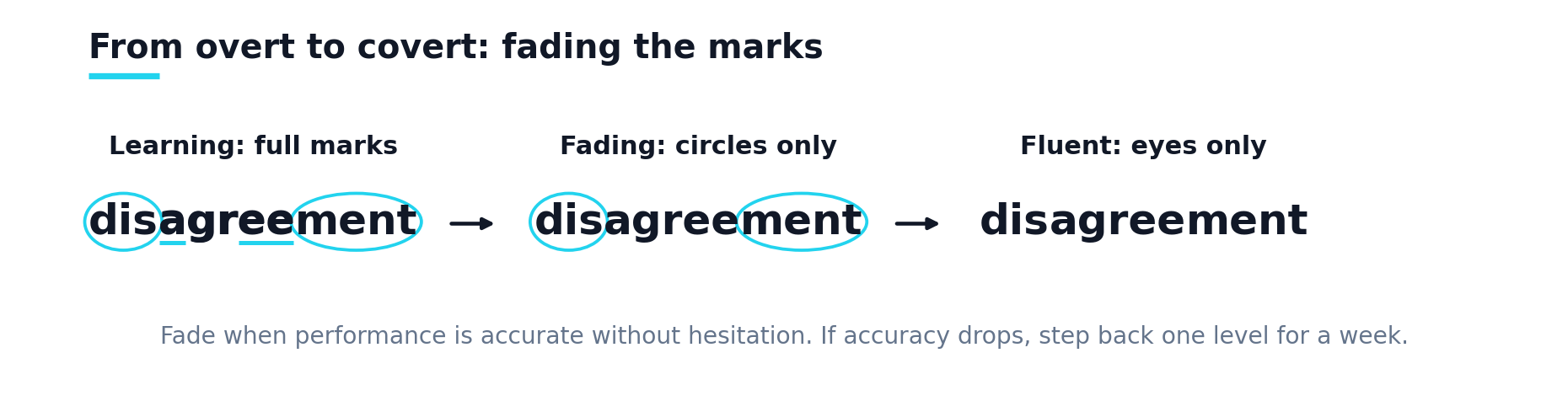
The circles and underlines are scaffolding, not the strategy. The Sourcebook is explicit about the endgame: as students become adept, the overt steps fade, and students identify affixes and vowels with their eyes instead of a pencil. A fifteen-year-old is never going to annotate a novel, and the strategy is only a success once it works without marks.
Fading is gradual and skill-based, not scheduled. A reasonable arc looks like this: full marking on every word while the steps are new; then marking only the words that resist a first attempt; then no marking, with the student talking through the steps aloud; then silent, internal use, which from the outside looks simply like a student who can read long words. The signal that a student is ready to fade a level is accurate performance without hesitation at the current level, on words with patterns they have practiced.
If accuracy drops after a fade, go back one level for a week without comment. The marks are a tool, not a badge of remediation, and returning to them briefly costs nothing.
Troubleshooting
The student's split does not match mine. Then it does not match yours, and that is fine. The only test of a split is whether it produced pronounceable parts that blend into the real word. Dep-end gets the same credit as de-pend. Correct a split only when it violates the one real rule: one part per vowel sound.
The student treats a two-syllable base as one lump. This is the most common mechanical error. The fix is already built into the strategy: send them back to their underlines. Two underlines means two parts, every time. If the lumping persists, the student is skipping Step 2, and the remedy is to make that step overt again for a while.
The student decodes the word accurately and still does not know it. Then the strategy worked and you have found a vocabulary moment, not a decoding failure. Say the word's meaning in a sentence and move on; better yet, log the word for vocabulary work. For multilingual learners this will happen regularly and means nothing bad about their decoding: the word simply is not in their oral vocabulary yet, so the Check it step has no answer key to consult. Weigh their nonsense-word and pattern accuracy more heavily than their real-word confirmation rate.
The student resists marking up words. Some older students experience the circling as babyish, which is a dignity signal worth respecting rather than overriding. Offer the trade explicitly: show me five accurate reads with no marks and the marks are optional. Students who can do it have earned the fade early; students who cannot usually accept the marks once the choice was theirs.
Practice words and what to do Monday
Build three graded sets of practice words, drawn from your students' actual content vocabulary wherever possible:
- Prefix + base: unclear, replay, mistrust, preview, subplot, nonfiction, disrupt
- Base + suffix: movement, teacher, careless, powerful, reaction, agreeable, darkness
- Prefix + base + suffix: disagreement, unbreakable, misjudgment, independence, international, prehistoric, reconstruction
Work set 1 until circling prefixes is automatic, then set 2, then set 3, and from there pull words straight from the week's science, history, and ELA texts.
Monday, then: pick five words from set 1, model one with the full think-aloud, and work the other four on whiteboards. That is the whole first lesson, and it is enough. The strategy is small by design; what makes it powerful is the same four moves, every day, on words that matter, until a student meets disagreement in the wild and takes it apart without thinking about it.
If you have not yet confirmed which of your struggling readers actually need this work, start with the companion guide, Phonics Intervention for Middle and High School, and its three quick checks.
References
- Archer, A. L., Gleason, M. M., & Vachon, V. (2006). REWARDS: Multisyllabic Word Reading Strategies. Sopris West.
- Honig, B., Diamond, L., & Gutlohn, L. Teaching Reading Sourcebook (3rd ed.). CORE / Arena Press.
- Institute of Education Sciences, What Works Clearinghouse. (2022). Providing Reading Interventions for Students in Grades 4-9 (WWC 2022007). ies.ed.gov
- Scammacca, N., Roberts, G., Vaughn, S., Edmonds, M., & Wexler, J. (2007). Interventions for Adolescent Struggling Readers: A Meta-Analysis with Implications for Practice. Center on Instruction.
- Shanahan, T. (2025). What role, if any, should phonics play in a middle school or high school? The answer may surprise you. Journal of Adolescent & Adult Literacy, 68, 325-329. doi.org/10.1002/jaal.1387
By Genevra Self, Juniper Reading CoLab. Free to print and share with your team. juniperreadingcolab.com
https://www.juniperreadingcolab.com/articles/flexible-strategy-big-word-decoding