He answers questions in class discussion. He follows the plot of the movie version. He has opinions about the characters. Then you ask him to read a paragraph aloud, and a word like "photosynthesis" stops him cold. He guesses "photographs." He skips it. He laughs it off and checks the clock.
If you teach middle or high school, you know this student. He is not rare. On the 2024 National Assessment of Educational Progress, 33 percent of eighth graders scored below the Basic level in reading, the largest percentage in the assessment's history.
Many of those students are not struggling because they lack intelligence or vocabulary or background knowledge. They are struggling because they never became fully accurate, automatic decoders, and the words got longer while their skills did not.
This guide is for the teachers, interventionists, and coaches who work with these students. It covers two things in depth: how to tell whether a struggling reader actually has a decoding problem, and where to start if they do. It also maps the surrounding territory: what an intervention block looks like, why fluency needs its own attention, why dignity is an instructional variable and not a courtesy, and which common practices to retire.
In this guide
- Does phonics even work for teenagers?
- First, make sure it is actually a decoding problem
- Where to start: the flexible strategy
- What a 10 to 15 minute intervention block looks like
- Fluency will not fix itself
- Dignity is an instructional variable
- Five practices to retire
- What to do Monday
- What the research says
Does phonics even work for teenagers?
It is a fair question, and the honest answer is more useful than the cheerleading answer.
The short answer is yes, for the students whose problem is actually decoding.
When phonics intervention has disappointed with adolescents, the most common reason is not that the treatment failed. It is that the treatment was given without a diagnosis.
Think of it like antibiotics. Antibiotics work. They do not work on viral infections. Prescribing phonics to every struggling adolescent reader, then concluding phonics does not work for adolescents, is the same error.
The question is no longer whether to teach word reading to older students who need it. The question is how to find the ones who need it, which is where this guide goes next. The research behind this answer is laid out near the end of the guide.
First, make sure it is actually a decoding problem
A low reading score is a symptom, not a diagnosis. A student who reads poorly may have a decoding deficit, a fluency deficit, a vocabulary deficit, or a comprehension deficit, and each one calls for different instruction. Phonics intervention is the right treatment for exactly one of them. Before you build anything, confirm which problem you are looking at.
You do not need special materials to get a working answer. Here are three checks you can run this week with one student, ten minutes, and a pencil. Run all three; each one rules something in or out, and together they give you a usable picture.
Check 1: The listening test
What to do
- Choose two short grade-level passages of similar difficulty.
- Read the first one aloud to the student, then ask a few comprehension questions.
- Have the student read the second one silently or aloud, then ask comparable questions.
What you are looking for
A gap. If the student understands the passage well when you read it and poorly when they read it, their language comprehension is intact and the breakdown is happening at the print level. That points toward decoding or fluency.
If comprehension is weak in both conditions, the problem lives in language, vocabulary, or knowledge, and phonics will not fix it.
Why it works
Reading comprehension is the product of two things: the ability to turn print into language, and the ability to understand language. This is the logic of the Simple View of Reading, and the listening test is the fastest classroom-level way to separate the two factors. You are holding language comprehension constant and seeing whether print access is the bottleneck.
Check 2: The multisyllabic word list
What to do
- Make a list of 8 to 10 multisyllabic words the student is unlikely to have memorized as wholes. Content-area words work well: fundamental, carnivorous, independence, magnetic, proclamation.
- Have the student read the list aloud, one word at a time.
- Write down exactly what they say for each word, including hesitations and self-corrections.
What you are looking for
Not just the error count, but where the attempt breaks down. There are three distinct failure points, and they call for different starting places:
- Letter-sound errors. The student misreads short vowels or consonant patterns inside the chunks ("mag-NEET-ic"). Foundational pattern knowledge is shaky.
- Chunking failures. The student knows the sounds but cannot break the word into workable parts. They read the first syllable, then guess the rest from its shape ("carni... carnivores? carnival?"). This is the most common profile in older students, and it means the student needs the flexible strategy, not letter drills.
- Flexing failures. The student produces a plausible but wrong pronunciation and cannot adjust it to match a real word ("pro-CLAM-ation" stated with confidence and never corrected). They can chunk but cannot flex, which is the last skill in the sequence.
Why it works
For older readers, decoding rarely fails on short words. It fails on length. A graded multisyllabic list shows you the exact rung of the ladder where the student's word solving gives out, which is also where instruction should start.
Check 3: The nonsense word check
What to do
- Write out 5 or 6 made-up words that follow regular English spelling patterns: glate, straim, bightful, condaze, mertain, plizzern.
- Tell the student directly that these are not real words, so there is nothing to recognize; the task is just to sound them out.
- Have them read each one aloud.
What you are looking for
The unmasking. Some students read grade-level real words acceptably and then fall apart on nonsense words at a much lower pattern level. If a student can read inflate but cannot read glate, they did not decode inflate. They recognized it.
Why it works
By middle school, struggling readers have spent years compensating. They memorize word shapes, lean on context, and build large sight vocabularies that mask weak decoding.
Research on pseudoword reading (Carver, 2003; Share and Stanovich, 1995) shows that nonsense words strip away every compensation strategy at once, because there is no visual memory to retrieve and no context to guess from. All that is left is the decoding system itself. This is why experienced teachers are routinely surprised by this check: the compensators are often the students who seemed fine.
A caution for multilingual learners
For multilingual learners, a real-word error is not automatically a decoding error. A student may decode gorge accurately and still hesitate because the word is not in their oral vocabulary. Weigh the nonsense-word evidence more heavily for these students, and involve whoever supports their language development before placing them in a phonics intervention.
Putting the three checks together
| What you saw | What it means | What to do |
|---|---|---|
| Listening gap present, word list breaks down, nonsense words fail | Decoding deficit | Phonics intervention is the right call, starting at the failure point the word list showed you. |
| Listening gap present, word list accurate but slow and effortful | Fluency deficit | The student needs volume and repeated reading more than pattern instruction. |
| No listening gap, comprehension weak in both conditions | Vocabulary, language, or knowledge deficit | Phonics is not the treatment, no matter how low the reading score is. |
| Accurate on real words, weak on nonsense words | A compensator | Treat as a decoding deficit even though the surface scores look fine, because the compensation strategy collapses as academic words get longer and rarer. |
These informal checks will correctly sort most students. Schools running intervention at scale typically systematize the same logic with a diagnostic decoding screener, which adds consistency across teachers and pinpoints a starting level. But the thinking is identical either way: match the intervention to the deficit, and confirm the deficit before you intervene.
Where to start: the flexible strategy
Start here, because this is the permission most secondary teachers need to hear: an older struggling reader almost never needs to start at letter sounds.
The diagnostic work above will occasionally surface a student with true foundational gaps, and those students need foundational instruction. But the most common profile by far is the student who can read cat and shade and cannot read fundamental. Their decoding does not fail on sounds. It fails on length.
That means the highest-leverage skill you can teach is a flexible decoding strategy: one consistent procedure for breaking a long word into parts, sounding the parts, and assembling a real word. The CORE Teaching Reading Sourcebook teaches a version of this under the name the flexible strategy, and the name is worth keeping, because flexibility is the point.
The IES practice guide is specific on this point, and its advice is liberating: rather than teaching a wide array of syllable rules, choose one routine with simple steps for breaking words apart and blending them back together, and make it flexible. You do not need students to classify six syllable types. You need them to get the word.
The four steps
Teach these four steps, in this order, every time, until the student does them without you:
- Peel the affixes. Circle any prefix or suffix: un-, dis-, re-, -ment, -tion, -able. Most multisyllabic words carry at least one, and peeling them shrinks the problem immediately: a twelve-letter word becomes a five-letter base. This step is why affix recognition is taught before the strategy, not during it.
- Spot the vowels in what is left. Underline every vowel or vowel team in the uncircled part. Each vowel sound anchors one chunk, so this step tells the student how many parts the base has before they say anything.
- Chunk and say the parts. Break the base into parts, one vowel sound per chunk, and read each part aloud in order, left to right, touching or pointing as they go. The split does not need to match the dictionary. De-pend and dep-end both work if they get the reader to the word.
- Flex and confirm. Reassemble the whole word, affixes included, and ask: is that a real word? If the first attempt sounds wrong, flex a vowel sound or shift the stress and try again. Pro-CLAM-a-tion... proclamation.
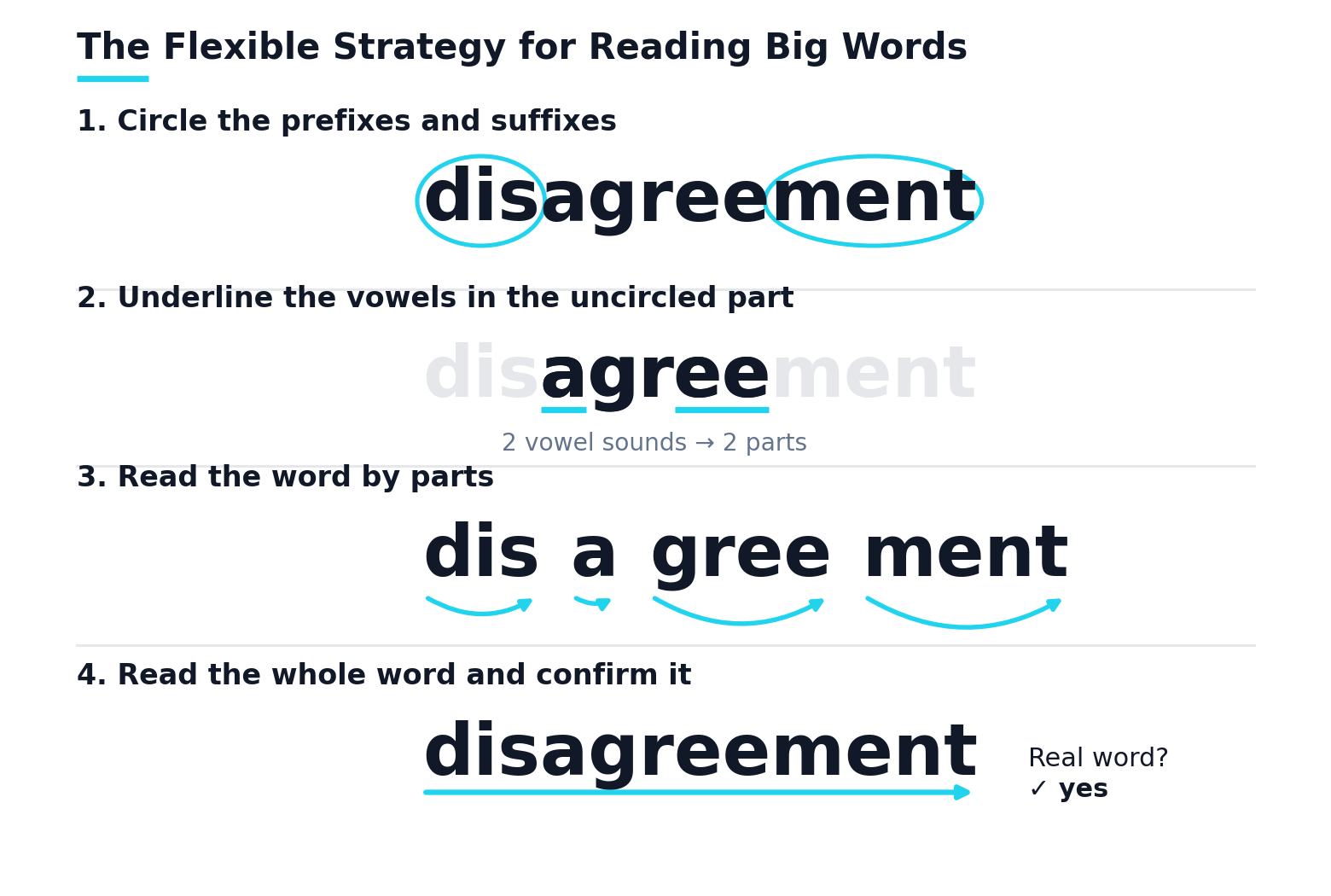
For the full walkthrough, with every step modeled on one word and a think-aloud script you can use as written, see The Flexible Strategy: How to Teach Big-Word Decoding Step by Step.
A worked example
Here is the strategy on the board with independence, narrated the way you would model it:
"First, affixes. I see in- at the front and -ence at the end, so I circle both. What is left is depend. Now vowels in what is left: e and e. Two vowel sounds, so two chunks. Chunk it and say the parts: de... pend. Now the whole word, affixes back on: in... de... pend... ence... indePENdence. Is that a real word? Almost. Flex the stress: independence. That is a word I know. Done."
The whole demonstration takes under a minute, which is the point. The routine is fast enough to use mid-sentence in a biology textbook, and that is where it has to work.
Flexing is the skill that makes it secondary-grade work
Step 4 deserves emphasis because it is what separates this from elementary phonics. English spelling is reliable but not perfectly predictable, especially about vowel reduction and stress in long words. A first attempt at committee or preparation often produces something close but wrong.
Elementary phonics instruction tends to treat decoding as apply-the-rule-get-the-word. Multisyllabic decoding is closer to hypothesis testing: generate a pronunciation, check it against your oral vocabulary, adjust.
Students who have never been taught to flex treat a wrong first attempt as failure and quit. Students who have been taught to flex treat it as step one of two. Naming this explicitly ("your first try is a draft") changes how students experience hard words.
Where the words come from
Pull practice words from the student's actual content classes: the science unit, the history chapter, the math vocabulary list.
This is not just efficient. It makes the intervention visibly about accessing photosynthesis and Reconstruction rather than about remedial reading, which matters for the reasons the dignity section below takes up. A routine practiced on carnivorous on Tuesday gets used on carnivorous in class on Wednesday, and that transfer moment is where students start believing the routine is theirs.
What a 10 to 15 minute intervention block looks like
Secondary schedules rarely offer more than a short daily block, and the good news is that a short block, run consistently, is enough. Here is a structure you can lift as-is:
| Step | Minutes | What happens |
|---|---|---|
| 1. Warm-up | 1-2 | Quick review of the vowel patterns appearing in today's words. Flash them, say them, move on. |
| 2. Flexible strategy | 4-5 | Apply the four steps to 5 to 8 new multisyllabic words, teacher modeling first, then students working the routine aloud. |
| 3. Spell it back | 2-3 | Students spell two or three of the same words from memory, chunk by chunk. |
| 4. Words in sentences | 2-3 | Read the words embedded in sentences or a short passage, because a word read in isolation is only half-learned. |
| 5. Repeated reading | 2-3 | One short passage read twice, with a stated purpose for the second read (see the fluency section). |
Two principles make the block work harder than its minutes suggest.
Volume. Research on word learning suggests students need something on the order of 4 to 14 exposures before a new word becomes automatic (Lyon, 1998), so a word should reappear across several sessions, not retire after one.
Mixing. Fold a few words from earlier weeks into each session's list without labeling them as review. Interleaved practice looks messier than blocked practice but produces more durable learning, and unlabeled mixing has the side benefit of never announcing to the student which words they are "still on."
Fluency will not fix itself
Expect this, so it does not discourage you: a student can make real decoding gains and still read slowly.
Torgesen and colleagues (2001) found that intensive phonics intervention produced major gains in decoding accuracy and comprehension for students with severe reading disabilities, but much smaller gains in fluency. The reason is not mysterious. Fluency is built by years of successful print exposure, and these students have spent years avoiding print. Fixing the decoding opens the door; it does not retroactively supply the mileage.
So fluency needs its own deliberate work, and the tool is repeated reading with a purpose. The same short passage, read two or three times, with each read assigned a different job:
- First for accuracy (get every word right, slow is fine).
- Then for smoothness.
- Then for expression.
The IES guide stresses the purpose part: rereading without a stated goal becomes rote quickly, while "this time, read it like the narrator means it" gives the second pass a reason to exist.
Keep passages short, keep the words decodable with the patterns the student owns, and expect rate to dip temporarily whenever word length jumps. Slower-but-accurate on longer words is progress, not regression.
Dignity is an instructional variable
Most advice about older struggling readers includes a polite sentence about age-appropriate materials, as if the issue were taste. It is not taste. It is learning conditions.
Adolescents are acutely attuned to status and respect. Yeager, Dahl, and Dweck (2018) reviewed why school-based interventions that work for children often fail with adolescents, and proposed that such efforts fail when they cut against adolescents' stronger need for respect and status. Their examples come from health and discipline, not reading, but the logic carries.
A fifteen-year-old handed a workbook with cartoon animals is not just embarrassed. Part of his attention is now on being seen with it, and that attention is no longer on the instruction. Infantilizing materials do not merely annoy older students; they work against the lesson.
The practical rules that follow:
- Never round-robin read. Reading aloud in front of peers is the single highest-threat activity you can ask of a struggling adolescent reader. Oral reading happens one-on-one or in a small group that has earned trust, never as public performance.
- Keep groups small and matched. Three to five students with similar profiles, so nobody is the group's visible weakest reader.
- Name the work carefully. The words you use to describe the intervention become the story students tell themselves about it. "We are learning to break down academic vocabulary" is true, accurate, and carries no elementary signal. "Phonics class" carries a signal every student decodes instantly, even the ones who cannot decode fundamental.
- Use their real academic words. Content-area vocabulary as practice material makes the purpose self-evident: this is about biology and history, not about catching up.
- Audit the materials themselves. Fonts, clip art, and example sentences all signal an intended audience. If a worksheet would look at home in a second-grade classroom, it is costing you learning regardless of how sound its content is.
None of this softens the instruction. The instruction stays explicit, systematic, and demanding. What changes is the signal around it.
Five practices to retire
- Phonics for every struggling reader. Treatment without diagnosis. A student whose deficit is vocabulary or comprehension loses intervention time to instruction that cannot help them, and the intervention's reputation loses with them. Diagnose first, always.
- Reaching for elementary materials because they are what is on the shelf. The content may be sound, but the packaging taxes learning (see above), and the word lists top out below what secondary students actually face. Materials built for older readers exist; use them.
- Expecting fluency to arrive on its own. Decoding gains do not automatically become fluency gains. Build repeated reading into the block from day one rather than waiting to be disappointed.
- Teaching the rules instead of the routine. Six syllable types, a dozen division rules, and exceptions to each make a curriculum that tests well on its own worksheet and never gets used mid-paragraph in a history textbook. One flexible routine, overlearned, beats an elaborate taxonomy.
- Skipping the spelling. If students only ever decode and never encode, the orthographic connections stay shallow. Two words spelled from memory per session is a small cost for the strongest consolidation move available.
What to do Monday
You do not need a program, a committee, or a budget line to begin. You need one student and ten minutes.
- Pick the student you suspect most and run the three checks: the listening test, the multisyllabic word list, the nonsense words. Write down what you see.
- If the evidence says decoding, teach the flexible strategy on five words from their actual content classes. Model it once, then hand it over.
- Protect ten minutes a day for it. Consistency beats intensity; a short block that happens daily will outperform a long one that happens when the schedule allows.
The students this guide is about have usually spent years being handed comprehension strategies for a problem that lives three levels lower. Finding the real problem, and treating that one, is the most respectful thing a school can do for them.
What the research says
The National Reading Panel (2000) found that systematic phonics instruction produced its strongest effects in kindergarten and first grade, with smaller but still positive effects for older struggling readers. For years, that finding was read as "phonics is an elementary thing." Plenty of secondary educators were told, explicitly or implicitly, that it was too late.
The research since then tells a more precise story. Scammacca and colleagues' meta-analyses of interventions for struggling readers in grades 4 through 12 (2007, 2015) found that reading intervention works for older students, and that word study holds up even under the strictest measurement: on standardized outcome measures, word study interventions showed a significantly greater effect than fluency interventions. The 2007 synthesis put it plainly: for older students struggling at the word level, word study intervention is an appropriate response.
Notice the condition in that sentence: struggling at the word level. That condition is the whole game. A ninth grader whose real problem is vocabulary or background knowledge will not improve from syllable work, and an intervention group that mixes her in with genuine decoding strugglers will wash out the effect for everyone.
Timothy Shanahan made a version of this case in the Journal of Adolescent and Adult Literacy (2025): there is a real place for phonics in secondary school, but it belongs to the students whose earlier decoding instruction was missing or did not take, not to every student with a low reading score.
The practical consensus now has federal backing. The Institute of Education Sciences practice guide Providing Reading Interventions for Students in Grades 4-9 (2022) lists building decoding skills for complex multisyllabic words as its first recommendation, backed by a strong level of evidence.
References
- Carver, R. P. (2003). The highly lawful relationships among pseudoword decoding, word identification, spelling, listening, and reading. Scientific Studies of Reading.
- Honig, B., Diamond, L., & Gutlohn, L. Teaching Reading Sourcebook (3rd ed.). CORE / Arena Press.
- Institute of Education Sciences, What Works Clearinghouse. (2022). Providing Reading Interventions for Students in Grades 4-9 (WWC 2022007). ies.ed.gov
- Lyon, G. R. (1998). Overview of reading and literacy initiatives.
- National Assessment of Educational Progress. (2024). The Nation's Report Card: Reading. nagb.gov
- National Reading Panel. (2000). Teaching Children to Read. National Institute of Child Health and Human Development.
- Scammacca, N., Roberts, G., Vaughn, S., Edmonds, M., & Wexler, J. (2007). Interventions for Adolescent Struggling Readers: A Meta-Analysis with Implications for Practice. Center on Instruction.
- Scammacca, N. K., Roberts, G., Vaughn, S., & Stuebing, K. K. (2015). A meta-analysis of interventions for struggling readers in grades 4-12: 1980-2011. Journal of Learning Disabilities, 48(4), 369-390. doi.org/10.1177/0022219413504995
- Shanahan, T. (2025). What role, if any, should phonics play in a middle school or high school? The answer may surprise you. Journal of Adolescent & Adult Literacy, 68, 325-329. doi.org/10.1002/jaal.1387
- Share, D. L., & Stanovich, K. E. (1995). Cognitive processes in early reading development. Issues in Education.
- Torgesen, J. K., et al. (2001). Intensive remedial instruction for children with severe reading disabilities. Journal of Learning Disabilities.
- Yeager, D. S., Dahl, R. E., & Dweck, C. S. (2018). Why interventions to influence adolescent behavior often fail but could succeed. Perspectives on Psychological Science, 13(1), 101-122. doi.org/10.1177/1745691617722620
By Genevra Self, Juniper Reading CoLab. Free to print and share with your team. juniperreadingcolab.com
https://www.juniperreadingcolab.com/articles/phonics-intervention-middle-high-school