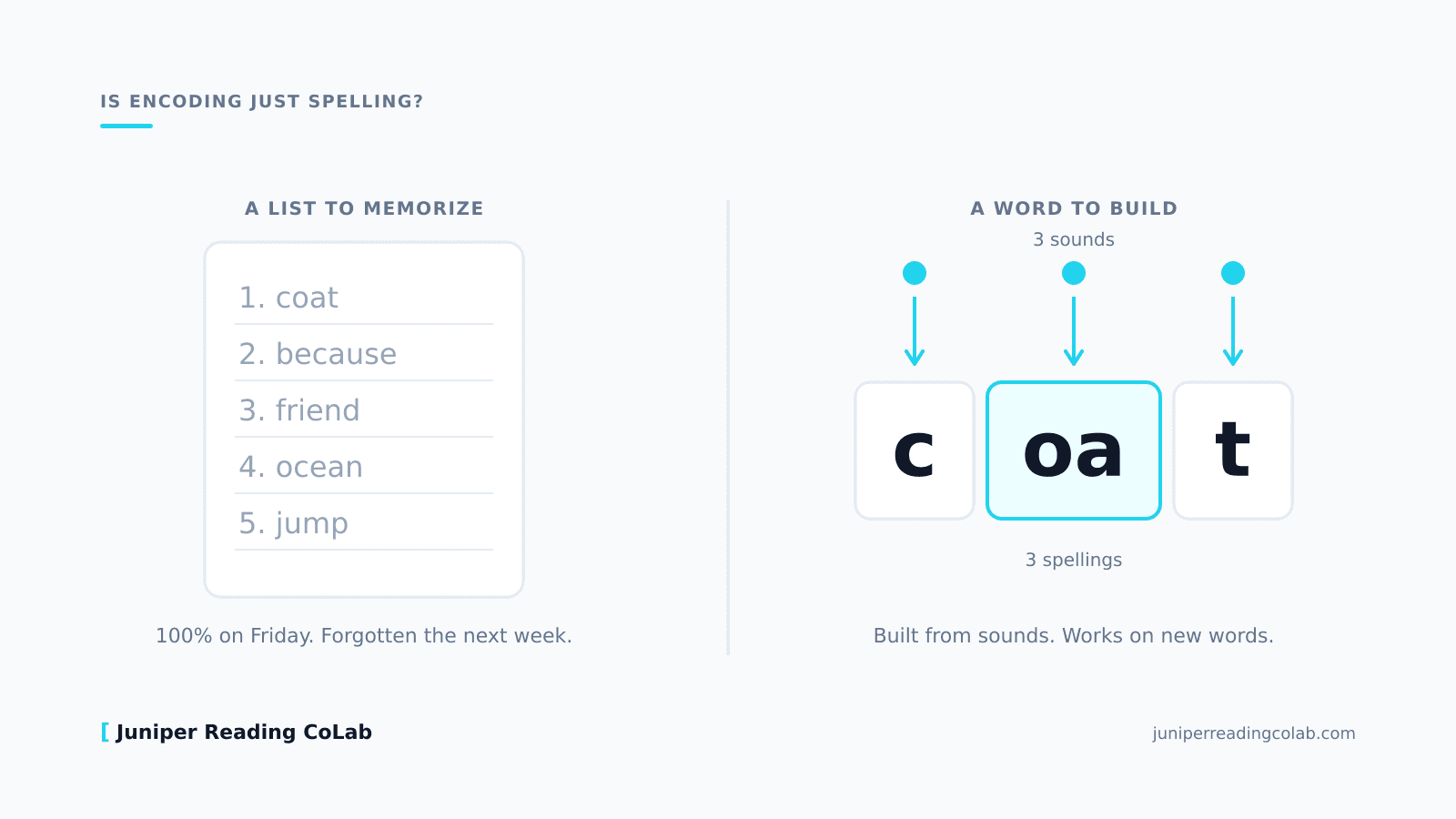
A weekly spelling list and encoding instruction are not the same thing. I taught one for years without teaching the other.
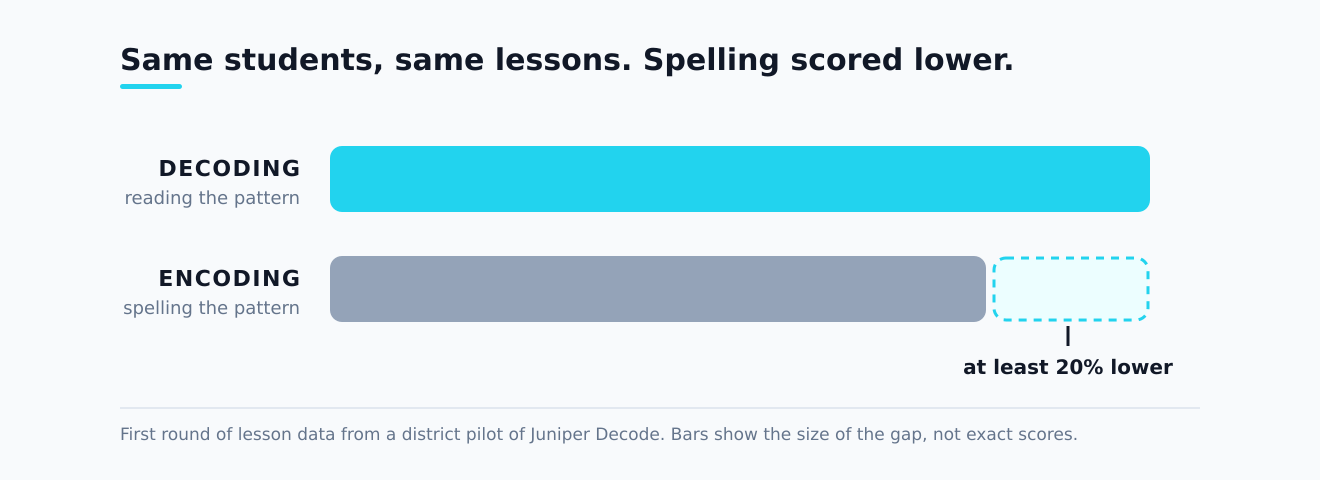
The short answer. Spelling is the finished product on the page. Encoding is the process that produces it: hearing a word, pulling it apart into sounds, and writing the letters for those sounds. A memorized list can get a student to 100% on Friday without teaching encoding at all. In a district pilot of Juniper Decode, students named spelling as the hardest part, and their encoding scores ran at least 20% lower than their decoding scores.
At the beginning of my career, spelling in my classroom was a weekly list and a Friday test.
The list did not follow a spelling pattern or a decoding pattern. The words were often pulled from the basal story of the week.
Students memorized them. They got 100% on Friday. The following week they could not spell the same words.
I did not like it. I did it anyway, because it was the expectation.
I have written before about what encoding is, what the research says, and 5 ways to add it to a lesson. This article picks up where that one stops. It covers why spelling and encoding get confused, what students using Juniper Decode told me, and what I am changing in Juniper Decode and Juniper Navigate because of it.
Spelling and encoding are not the same thing
I was not trained to teach phonics in college or in my first 10+ years as a teacher. So I never connected spelling to phonics. Spelling was one thing and reading was another.
Later I moved away from weekly spelling tests. By then I understood decoding, and the importance of explicit phonics instruction and practice. I still did not fully understand the importance of encoding, or how it connected.
Here is the difference I could not see then.
| A weekly spelling list in my classroom | Encoding instruction | |
|---|---|---|
| Where the words come from | The story of the week | The pattern students are learning to read |
| What students do | Memorize the letters in order | Pull the word apart into sounds and write the letters for each sound |
| What it connects to | Nothing in the reading lesson | The same pattern taught in decoding |
| What I saw afterward | 100% on Friday, forgotten the next week | Patterns that carried over |
The right-hand column is what I saw with Making Words and Making Big Words, from Patricia Cunningham and Dorothy Hall. Students played with the patterns and built words instead of memorizing them. They liked it. And the patterns carried over in a way the lists never did.
Parents love spelling lists, and I understand why. A list is something a family can help with.
Nobody in that picture is doing anything wrong. The teacher is doing what is expected. The parent is helping. The student is studying. My lists gave students words to study. They did not teach the patterns students could use to spell other words.
One caution. Spelling asks for a little more than sounds. Rain and reign sound the same. To spell the right one, a student also has to know which word is meant.
What the research says
The earlier article covers the research in more depth. Here is the short version.
- Teaching spelling directly works. A meta-analysis of 53 studies and 6,037 students in kindergarten through 12th grade found that formal spelling instruction beat no instruction and beat picking it up along the way. Students spelled more accurately in their writing, and reading improved too. The benefits were generally consistent across grade levels, though the advantage was smaller for older students (Graham and Santangelo, 2014).
- Encoding instruction improves reading as well as spelling. A synthesis of studies found that held for young students at risk, mainly in kindergarten through 3rd grade, and for older students who were still reading below a 3rd grade level. The authors noted that early reading programs taught decoding but did not always give encoding the same attention (Weiser and Mathes, 2011). That may be changing with science of reading training.
- Spelling is not a memorization task. Joshi and colleagues wrote in American Educator that teachers often told them they taught spelling through whole-word memorization (Joshi et al., 2008). I was one of those teachers.
- Spelling can be harder than reading. When students read a word, the spelling is in front of them. When they spell it, they have to supply it themselves (Williams et al., 2017).
What students told me
Juniper Decode is a structured phonics intervention app for grades 3 through 12. The app delivers the explicit instruction, so a teacher does not have to be trained in phonics to use it.
Each lesson moves through gradual release.
- I do. The app teaches the pattern directly and models how to read it.
- We do. Students practice the pattern with support, and get coaching when they make an error.
- You do. Students read the pattern on their own.
That is the same explicit instruction and gradual release that shaped how I taught and coached. Every lesson asks students to decode and to encode.
In the first round of feedback from a district pilot, students were asked which part they struggle with the most.
From the pilot. The majority of students said the spelling part. Their lesson scores agreed. Encoding ran at least 20% lower than decoding.
Why the gap is there
When I went back through the lessons, I could see one likely reason.
The decoding work gets explicit instruction and gradual release, with scaffolds at each step. I had built far more guidance into reading the pattern than into spelling it.
Students are carefully taught to read the pattern. Then they are asked to spell it with much less help.
A note on the evidence. The pilot data shows the gap. The lesson review is my explanation for it, not proof. Spelling can also be harder than reading on its own, as the research above says.
What is changing in Juniper Decode
What is there now. Levels 1, 2, and 3A have extra encoding practice. There is a word-building activity with the pattern being taught, a lot like Making Words, plus a warm up.
What is missing. The upper levels do not have that. I saw the gap while talking through the data with the district leader running the pilot.
What is changing. Every level of Juniper Decode is getting more encoding practice, with more guided support built into it. That work happens over winter break, before the pilot picks back up for second semester.
What is changing in Juniper Navigate
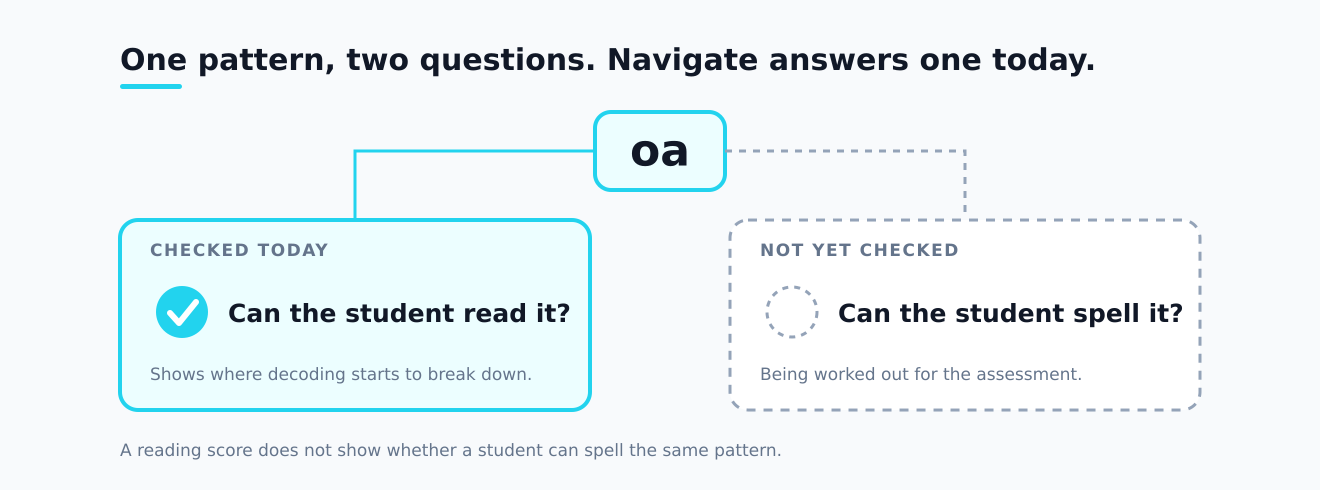
What it does now. Juniper Navigate is a free phonics placement screener. It shows where a student's decoding starts to break down, so instruction can start in the right place.
What it does not do. It has never included encoding. It does not show which of those same patterns a student can spell.
What I am working out. I think encoding needs to be part of the Juniper Navigate assessment. I do not have the design for it yet.
What to do tomorrow
Here is what I would tell my earlier self.
- Teach spelling with the same pattern students are learning to read. My old lists followed no pattern. Students had nothing to hold on to except memory.
- Have students build and change words. That is what Making Words did in my classroom. Copying and memorizing a list does not do the same work.
- Give encoding the same explicit instruction and gradual release you give decoding. In Juniper Decode, I built far more guidance into reading a pattern than spelling it. Encoding is where students scored lowest.
- Know that encoding can be harder than decoding. Students told me it was the hardest part. It is not a sign that students are not trying.
- Look at encoding on its own. A student can read a pattern and still not be able to spell it. A reading score will not show you that.
For where encoding fits in a full intervention block, see the complete guide to phonics intervention for middle and high school. For routines you can use in 2 or 3 minutes, see the 5 ways to build encoding into a lesson.
I taught spelling for years without teaching encoding. Then I built an app that taught decoding carefully and gave encoding less support than it needed. Students were the ones who pointed it out. Juniper Decode is being rebuilt around what they said.
Frequently asked questions
Is encoding just spelling?
Not quite. Spelling is the finished word on the page. Encoding is the process that gets it there: hearing a word, pulling it apart into sounds, and writing the letters for those sounds. A student can memorize a spelling without encoding it.
What is the difference between encoding and decoding?
Decoding goes from print to speech. A student sees the letters and reads the word. Encoding goes from speech to print. A student hears the word and spells it. Both draw on much of the same knowledge.
What is an example of encoding and decoding?
Take the word coat. In decoding, a student sees coat, connects c, oa, and t to their sounds, and blends them into the word. In encoding, a student hears coat, pulls it apart into 3 sounds, and writes c, oa, t.
Is a weekly spelling test the same as encoding instruction?
No. A list can be memorized for Friday and forgotten the next week. Encoding instruction ties spelling to the pattern students are learning to read, so they can spell words they have not studied.
Which is harder, encoding or decoding?
Encoding can be harder. In reading, the spelling is in front of the student. In spelling, the student has to supply it.
Do middle and high school students still need spelling instruction?
The research says it still helps. Graham and Santangelo (2014) found benefits of formal spelling instruction from kindergarten through 12th grade, with a smaller advantage for older students.
Does Juniper Decode teach encoding?
Yes. Every lesson asks students to decode and to encode. More encoding practice with more guided support is being added to every level.
Does Juniper Navigate assess spelling?
Not yet. Juniper Navigate shows where a student's decoding starts to break down. Adding encoding to the assessment is being worked out.
References
- Graham, S., & Santangelo, T. (2014). Does spelling instruction make students better spellers, readers, and writers? A meta-analytic review. Reading and Writing, 27(9), 1703-1743.
- Joshi, R. M., Treiman, R., Carreker, S., & Moats, L. C. (2008). How words cast their spell. American Educator, 32(4).
- Weiser, B., & Mathes, P. (2011). Using encoding instruction to improve the reading and spelling performances of elementary students at risk for literacy difficulties: A best-evidence synthesis. Review of Educational Research, 81(2), 170-200.
- Williams, K. J., Walker, M. A., Vaughn, S., & Wanzek, J. (2017). A synthesis of reading and spelling interventions and their effects on spelling outcomes for students with learning disabilities. Journal of Learning Disabilities.
By Genevra Self, Juniper Reading CoLab. Free to print and share with your team. juniperreadingcolab.com
https://www.juniperreadingcolab.com/articles/is-encoding-just-spelling