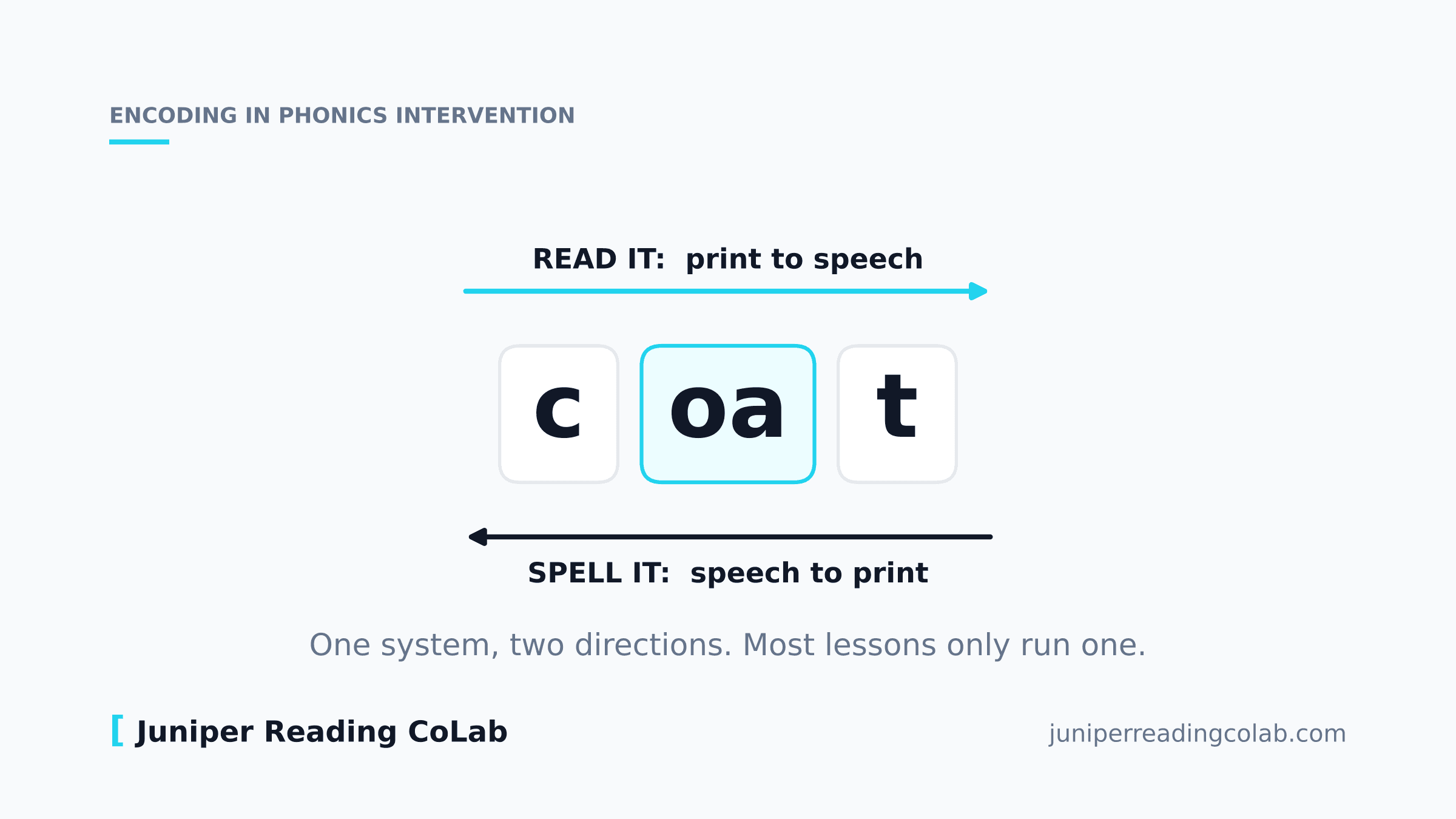
A phonics lesson that never asks students to spell is exercising half the system. This article covers why encoding belongs in every block, why it keeps getting cut, and five ways to add it in two to three minutes, with a worked teacher script.
The short answer: Decoding turns print into speech (reading a word). Encoding turns speech into print (spelling a word). Both use the same letter-sound connections, running in opposite directions, and practicing encoding strengthens decoding.
Picture a phonics lesson that goes well. The teacher reviews the vowel team ai, the group blends a set of words, reads them in sentences, and the students leave having read accurately for ten solid minutes. By every observable measure, the lesson looks complete.
One thing never happened. No student produced a word. Pencils stayed down, whiteboards stayed blank, and every word the students touched arrived fully formed on a card or a screen. The lesson exercised exactly half of the phonics system and left the other half untouched.
Decoding and encoding are one system running in two directions
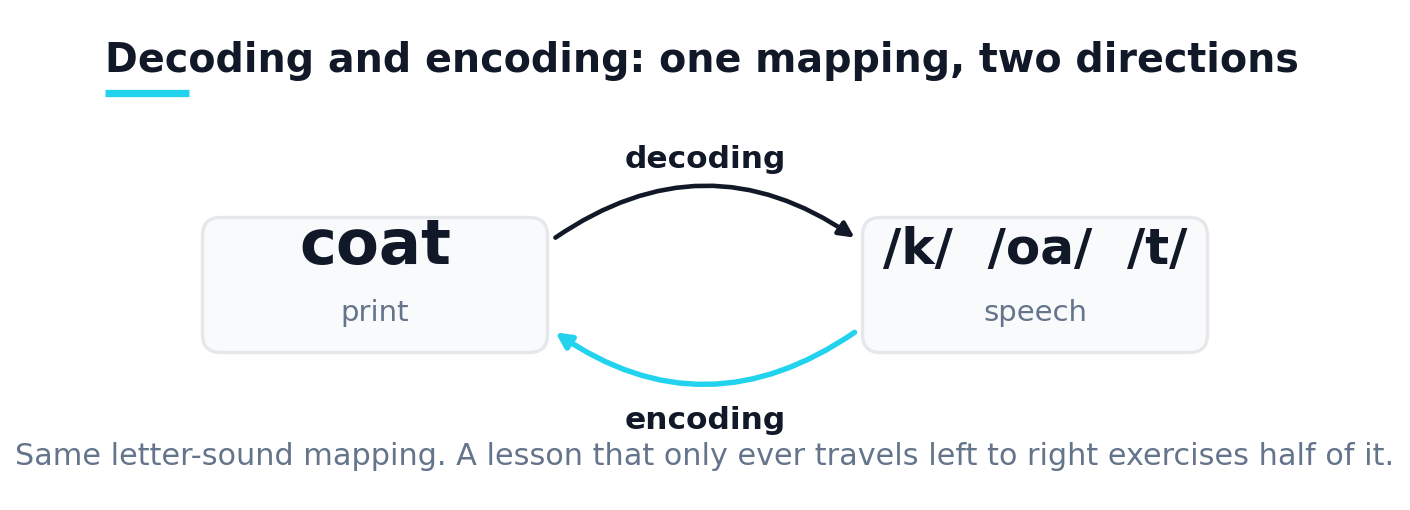
Decoding turns print into speech. Encoding turns speech into print. They draw on the same letter-sound mappings, the same patterns, the same word structure. A student who reads coat is traveling one direction across that mapping. A student who spells coat is traveling the other.
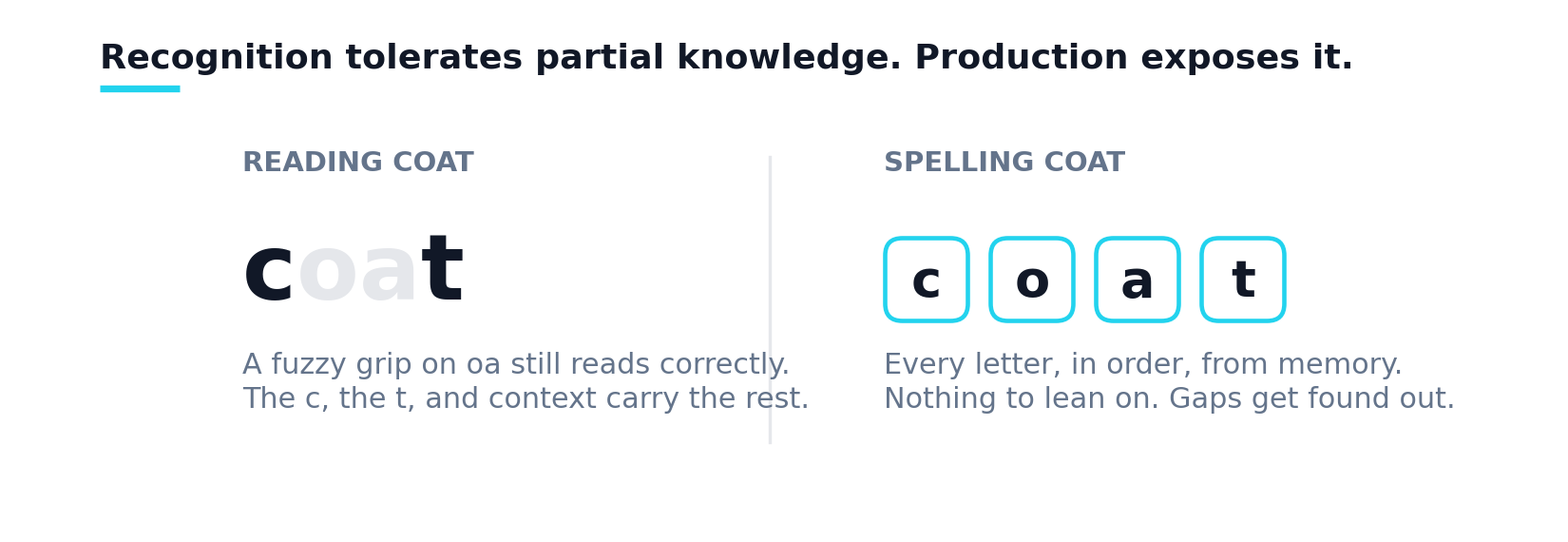
The difference is what each direction demands. Recognition tolerates partial knowledge. You can recognize a coworker's face in a crowd without being able to draw it, because recognition only requires enough detail to separate that face from the others around it. Drawing the face from memory requires all of it: the proportions, the spacing, every feature in its place.
Spelling is the drawing. A student can read coat with a fuzzy, approximate grip on the oa pattern, using the c and the t and the context to carry the rest. To spell coat from memory, the student has to retrieve the whole thing, letter by letter, with nothing to lean on. Encoding is where approximate knowledge gets found out.
That is precisely what makes it valuable in an intervention block, and precisely why it so often disappears from one.
The research is not subtle about this
The mechanism is orthographic mapping, Ehri's (2014) account of how words become instantly readable. A word moves into permanent memory when its spelling, pronunciation, and meaning get bonded together, letter to sound, with nothing skipped. Ehri describes the connections as the glue. Decoding builds those connections. Encoding builds the same connections under stricter conditions, because producing a spelling from memory requires the complete letter-by-letter specification that recognition lets a reader skip. Every act of accurate spelling is a full rehearsal of exactly the bonds that make a word automatic.
The intervention evidence matches the mechanism.
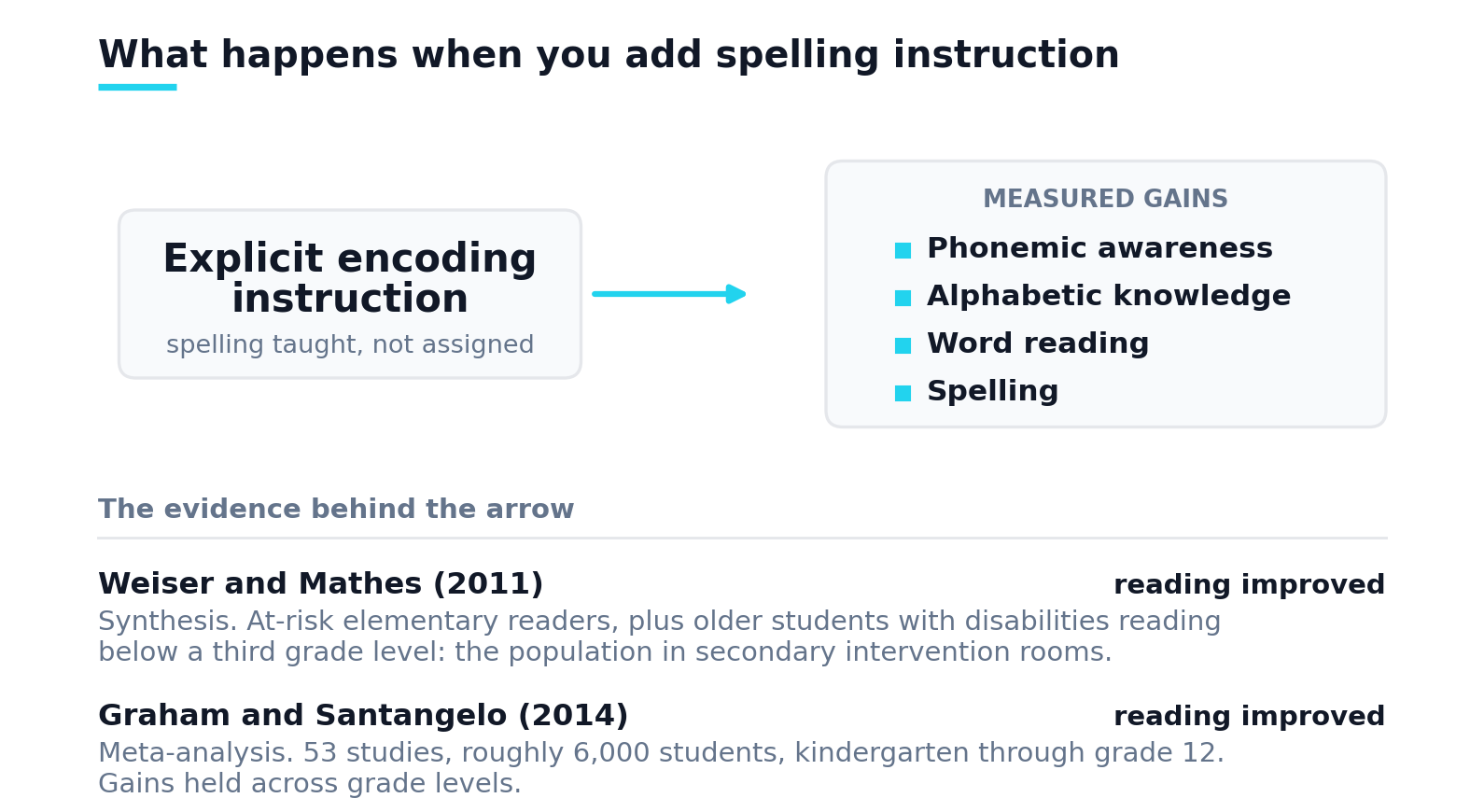
Notice what both studies measured: teaching students to spell made them better readers. Spelling instruction is reading instruction arriving through the side door. And the Weiser and Mathes population, older students reading far below level, is precisely who sits in secondary intervention rooms.
So the case for encoding is not that spelling is a nice-to-have literacy skill, although it is also that. The case is that encoding practice strengthens the exact mapping your decoding instruction is trying to build, and does it under conditions that expose every gap recognition papers over. A phonics lesson without encoding is leaving measurable reading growth on the table.
Why encoding disappears anyway
If the evidence is this clear, the interesting question is why so many phonics lessons still run decode-only. Four reasons, all understandable, none good enough.
Time pressure rewards the faster activity. Reading a word takes two seconds. Spelling one takes fifteen, plus the writing, plus the checking. When an intervention block is already squeezed to ten or fifteen minutes, the slow activity is the first one cut, and spelling is always the slow activity. The math feels responsible in the moment. It quietly trades away the practice with the highest payoff per word.
Spelling got filed under a different subject. In most schools, spelling lives in a separate curricular box: a weekly list, a Friday test, a grade in a different column. The list rarely has anything to do with the phonics pattern being taught that week, so spelling and decoding never meet. A teacher can be delivering careful phonics instruction and dutiful spelling instruction at the same time and have the two pass each other without touching. Why spelling and encoding get confused, and what students in a district pilot said about it, is in Is Encoding Just Spelling?.
Decoding progress photographs better. A student reading a word list aloud is visible, countable progress. A whiteboard of spelling attempts is messier: half right, letters reversed, vowels missing. The mess is actually the diagnostic gold, but in the moment it reads as failure, and lessons drift toward the activity that looks like success.
With older students, errors feel dangerous. A fourteen-year-old misspelling a word in front of peers is exposed in a way that a fourteen-year-old silently misreading one is not. Teachers protect students by not asking. The instinct is decent and the conclusion is wrong: the fix is to make the errors private and routine, not to stop collecting them.
Five ways to build encoding in without adding a minute
None of these require new materials or a longer block. They require a whiteboard, a marker, and the words you were already teaching.
| # | Strategy | The move | Time |
|---|---|---|---|
| 1 | Spell it back | Dictate two or three of today's decoded words; students write from memory | 2 min |
| 2 | Say it, stretch it, write it | Segment the word into sounds before writing, one grapheme per sound | Seconds per word |
| 3 | Word chains | Change one sound at a time: coat, goat, goal, foal | 90 sec |
| 4 | One dictated sentence | A single sentence holding two or three pattern words | 1 min |
| 5 | Spell it by parts | Multisyllabic words written part by part, affixes as units | 2 min |
The details, in the order you should add them:
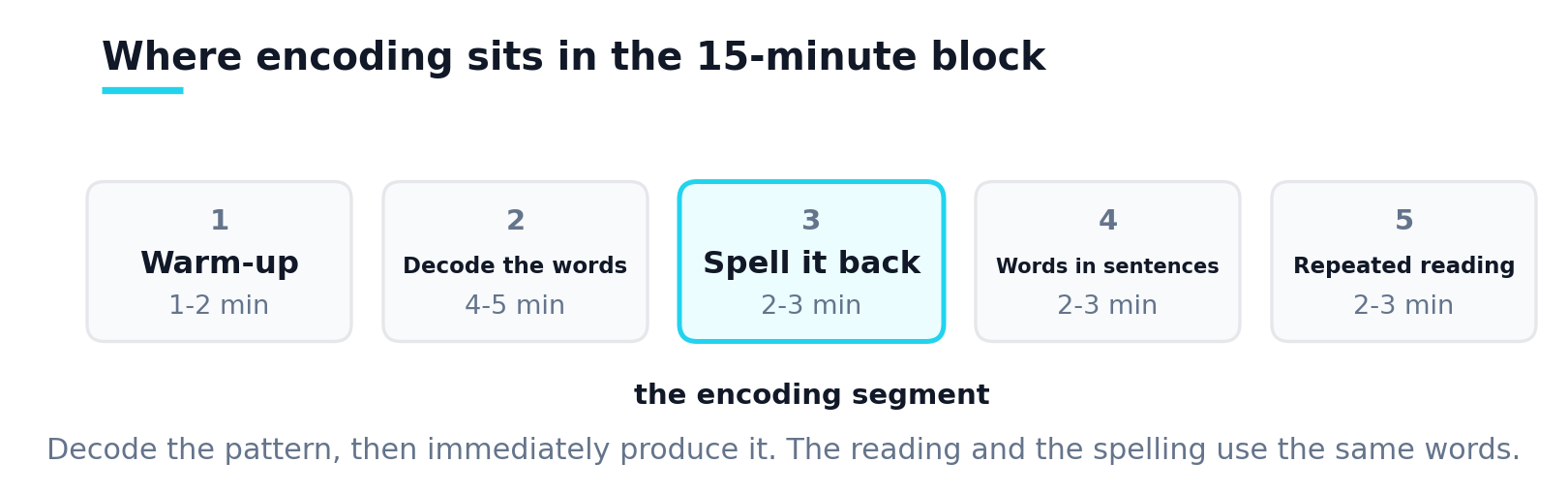
1. Spell it back. The simplest move and the one to start with. After students have decoded the day's words, pick two or three of them, erase or cover everything, and dictate the words back. Students write from memory, not from a model. Say the word, have students repeat it, then write. Two words done this way is two minutes, and it converts the day's reading practice into a direct test of whether the pattern actually stuck.
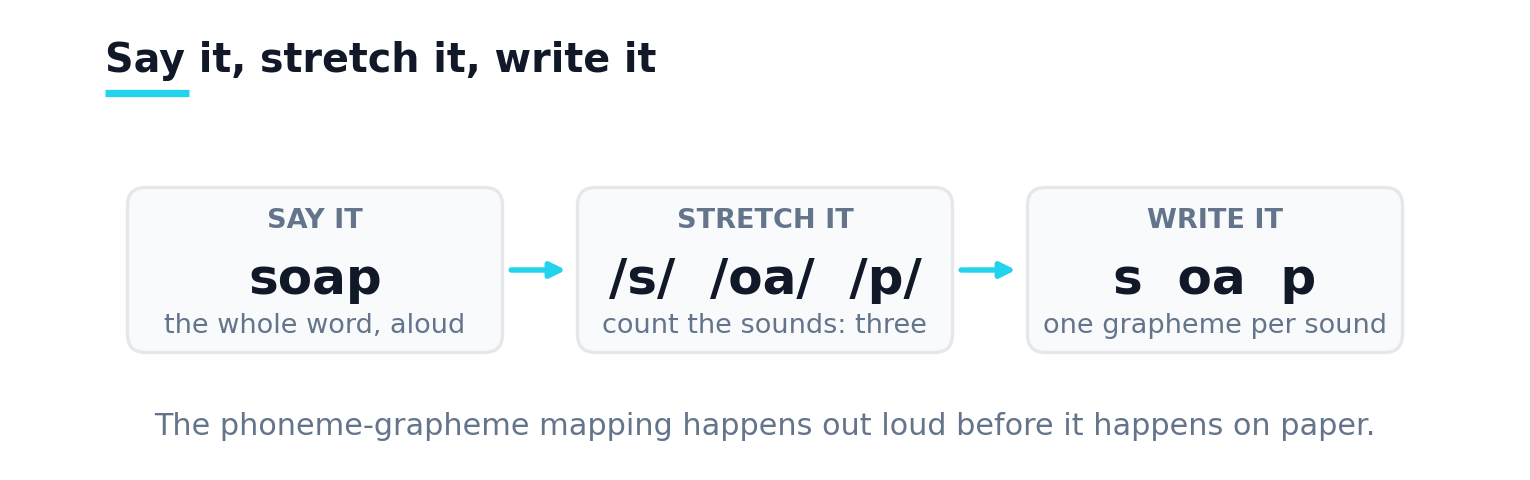
2. Say it, stretch it, write it. For students whose spellings come out with sounds missing, add a segmenting step between hearing and writing. The student says the word, stretches it into its sounds (coat becomes /k/ /oa/ /t/), counts or taps the sounds, then writes one grapheme per sound. This makes the phoneme-grapheme mapping explicit instead of hoping it happens internally. It is the same routine elementary programs use, stripped of anything that signals elementary: no picture cards, no song, just a word, a tap, and a pencil.
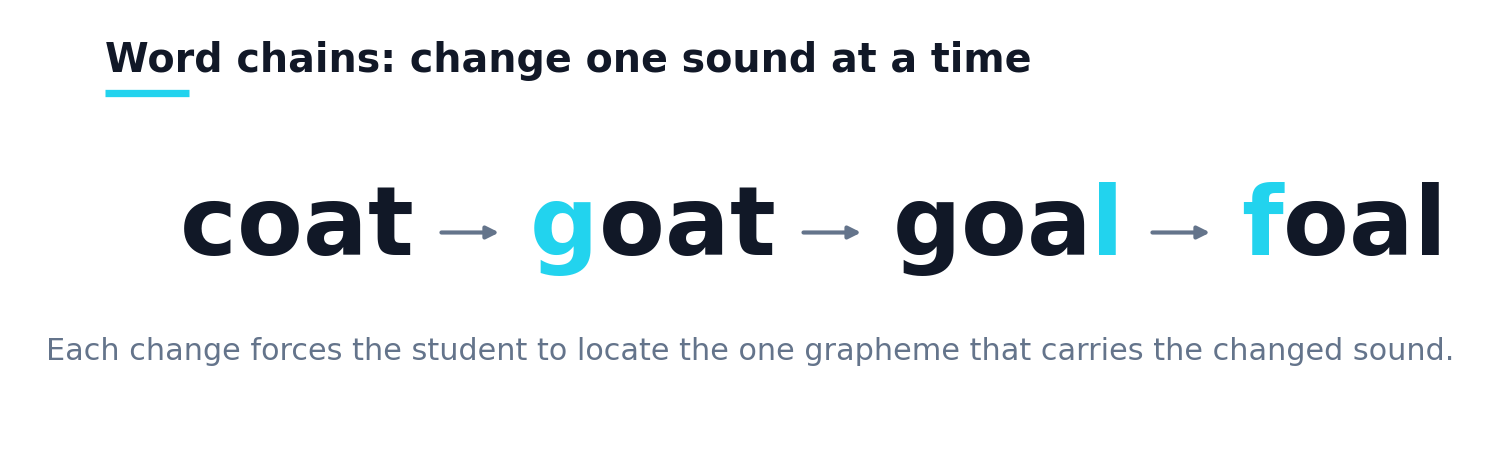
3. Word chains. Dictate a word, then change one sound at a time: coat to goat to goal to foal. Each change forces the student to locate exactly which grapheme carries the changed sound and swap only that one. Five words in a chain is maybe ninety seconds and delivers more phoneme-level analysis than a page of worksheet items.
4. One dictated sentence. Once words are landing, dictate a single sentence containing two or three pattern words: The goat ate the soap on the road. Sentence dictation adds the load of holding words in memory while writing, which is the condition under which spelling actually happens in real life. One sentence, not five. The point is quality of analysis, not volume.
5. Spell it by parts. For multisyllabic words, encoding runs through the same flexible strategy students use to decode them, in reverse. The student says the word, breaks it into parts aloud (dis, agree, ment), then writes it part by part, saying each part as they write. Affixes get spelled as units, because students who have learned that ment is a chunk can spell it as a chunk. This is where encoding practice and the flexible strategy reinforce each other: every word spelled by parts is another rehearsal of the same structural analysis.
Start with the first strategy alone. When two minutes of spell it back feels routine, the others slot in as variations, not additions.
What three minutes of encoding looks like
Here is the encoding segment from a 15-minute decoding block on the vowel teams ai and oa, placed right after the group has decoded the day's word set. The group has just read coat, soap, road, paint, trail, braid and a few others. Whiteboards come out. The script is verbatim so you can hear the pace.
Teacher: Markers up. First word: soap. I washed my hands with soap. Say it.
Students: Soap.
Teacher: Stretch it.
Students: /s/ /oa/ /p/.
Teacher: Three sounds. Write it.
Students write. The teacher watches the boards, not the students' faces. One student writes sope.
Teacher: Boards up. Check: s, oa, p. The middle sound is the vowel team o-a, the one from today's list. Fix it if you need to, then erase.
No name attached to the error, no pause on it. The student who wrote sope just got the most useful ten seconds of the lesson: the exact pattern they are treating as interchangeable, named and corrected while the word is still in their hand.
Teacher: Next word: trail. We hiked the trail. Say it.
Students: Trail.
Teacher: Stretch it.
Students: /t/ /r/ /ai/ /l/.
Teacher: Four sounds. Write it.
Same cycle: write, boards up, check against the pattern, erase. Then one sentence to finish.
Teacher: Last one, a whole sentence. Listen first: Stay on the road. Say it.
Students: Stay on the road.
Teacher: Write it. Capital at the front, period at the end.
Boards up, quick check, done. That is the whole segment: two words and a sentence, maybe three minutes. The errors it surfaces tell you tomorrow's warm-up. A student who wrote sope needs more contrasts between o-consonant-e and oa. A student who wrote rode for road is spelling a real word from memory, which is a different and better problem. You are not just practicing; you are collecting data the reading never shows you.
Keeping it low-threat for older students
Encoding is the most exposing activity in a phonics lesson, which is exactly why the logistics matter more here than anywhere else.
Whiteboards, not paper. A whiteboard spelling lives for ten seconds and gets erased. Nothing goes in a folder, nothing gets collected, nothing gets graded. The impermanence is the point: it tells students this is practice, not evidence against them.
Correct against the pattern, not the person. The check sounds like "the middle sound is the vowel team o-a," never "Marcus, look at yours again." Every student fixes their own board privately. The teacher saw who needs what; nobody else did.
Keep the volume small and the cycle fast. Two or three words per session, every session, beats a ten-word dictation once a week. Frequency builds the mapping. Volume builds dread.
And be clear about what this is not. It is not a weekly spelling list disconnected from your phonics sequence. It is not copying words off the board, which exercises handwriting and nothing else. It is not whole-word memorization of irregular words, which has its own small place but does not build the mapping. Encoding practice means producing pattern words from memory, immediately after decoding the same pattern, with an immediate check. Everything else wearing the name spelling is a different activity.
The cheapest upgrade available
Most improvements to an intervention block cost something: more time, new materials, different grouping. This one costs a whiteboard and two minutes you reassign from the activity with the lower payoff. If your students decode a pattern today, they spell two of its words back today. That single habit, held every session, is the difference between a lesson that exercises half the system and one that builds the whole mapping.
For where this sits in the larger picture: the full intervention block, including the spell it back step, is laid out in the complete guide to phonics intervention for middle and high school. The decoding routine that pairs with spelling by parts is in The Flexible Strategy: How to Teach Big-Word Decoding Step by Step. For the prefixes, suffixes, and roots that spelling by parts depends on, see how to teach word parts as a decoding tool. And the printable 15-minute block lesson plan, which includes the encoding segment with a filled sample, is here:
The 15-Minute Decoding Block lesson plan (printable) (PDF, 12 KB)
Frequently asked questions
What is the difference between encoding and decoding?
Decoding turns print into speech: a student sees the word coat and reads it aloud. Encoding turns speech into print: a student hears the word coat and spells it. Both run on the same letter-sound mappings, in opposite directions.
What does encoding mean in reading?
Encoding is the process of turning spoken sounds into written letters. A student hears a word, breaks it into its sounds, and writes the letter or letters for each sound. In reading instruction, encoding is the spelling side of phonics.
Is encoding the same as spelling?
Close. Spelling is the product; encoding is the process that produces it: hearing the sounds in a word and mapping each one to letters. Memorizing a weekly list can produce correct spellings with very little encoding, which is why encoding practice works from the phonics pattern being taught.
What is orthographic mapping?
Orthographic mapping is the process, described by Ehri (2014), that makes words instantly readable. A word is stored in long-term memory once its spelling, pronunciation, and meaning are bonded together, letter by letter and sound by sound.
Does spelling instruction improve reading?
Yes. Explicit encoding instruction produces measured gains in word reading as well as spelling (Weiser and Mathes, 2011; Graham and Santangelo, 2014). Spelling a word from memory rehearses the same letter-sound connections decoding depends on, without letting partial knowledge slide.
How do I add encoding to a phonics lesson?
Start with spell it back: after students decode the day's words, cover them, dictate two or three, and have students write each one from memory. Check against the pattern and move on. It takes about two minutes.
Is a weekly spelling list the same as encoding practice?
No. Encoding practice means spelling words that follow the phonics pattern just taught, right after decoding them, with an immediate check. A weekly list that isn't tied to the phonics sequence works on memorization, not the mapping.
References
- Ehri, L. C. (2014). Orthographic mapping in the acquisition of sight word reading, spelling memory, and vocabulary learning. Scientific Studies of Reading, 18(1), 5-21.
- Graham, S., & Santangelo, T. (2014). Does spelling instruction make students better spellers, readers, and writers? A meta-analytic review. Reading and Writing, 27, 1703-1743.
- Weiser, B., & Mathes, P. (2011). Using encoding instruction to improve the reading and spelling performances of elementary students at risk for literacy difficulties: A best-evidence synthesis. Review of Educational Research, 81(2), 170-200.
By Genevra Self, Juniper Reading CoLab. Free to print and share with your team. juniperreadingcolab.com
https://www.juniperreadingcolab.com/articles/encoding-phonics-intervention