Five root causes. None of them started in middle school. All of them teachable.
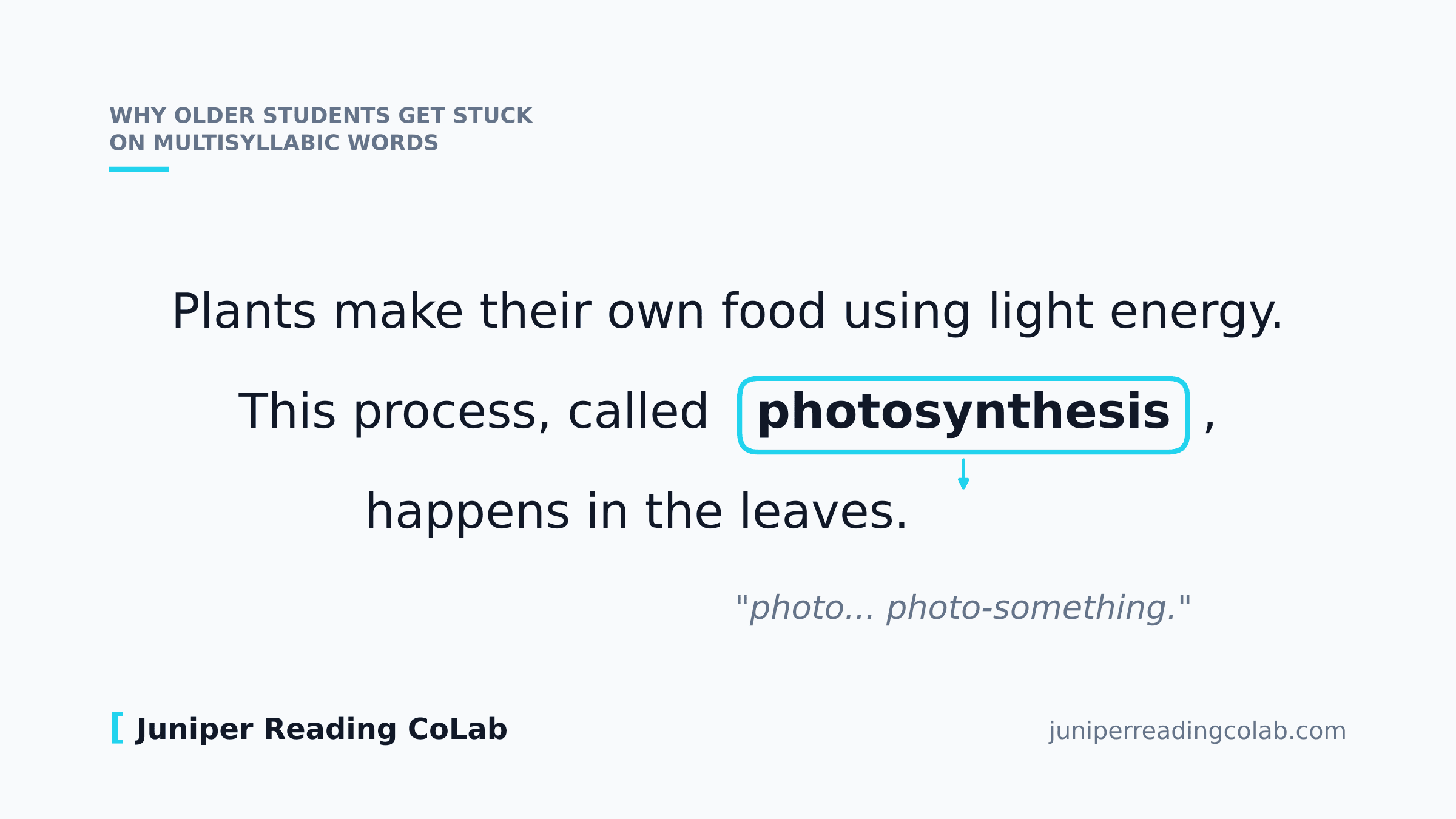
Fourth period. You ask a student to read a short paragraph from the science text, because he handled the warm-up fine and the paragraph is only three sentences. He is fine, for eleven words. Then he reaches photosynthesis, and you watch him do the thing: the pause, the quick glance up to check who is watching, the first syllable ventured twice, and finally a mumbled "photo-something" pitched low enough that you are invited to supply the word and move on. You supply the word. The class moves on. He does not.
Here is what makes that moment so confusing from the front of the room: he read the other eleven words. His grades and his reading assessments say he reads. He is not a beginning reader, so you reach for the explanations that are available to you. He skipped the homework. He was not paying attention. He has stopped caring.
I made every one of those guesses from my own fifth grade classroom, and I was wrong every time, until I took a phonics instruction class my district was offering. Nothing in my training before that class had ever named the real explanation. Later, as an instructional coach, I ended up teaching that same class to teachers across my district, and I watched the recognition land in building after building: they had been making the same guesses about the same moment, because nobody had offered them the explanation either.
Here is the good news: that student is not a mystery. He is a pattern, and the pattern has five root causes you can learn to spot from the front of the room. You will not need a new curriculum or an extra prep period. A whiteboard and tomorrow's class are enough.
It looks sudden. It is not.
Here is the version of the story teachers usually inherit: the student was fine in elementary school, something went wrong, and now he cannot handle middle school reading. Parents hear it too, and everyone goes looking for the recent cause. A bad year, a disengaged kid, too much time on a phone.
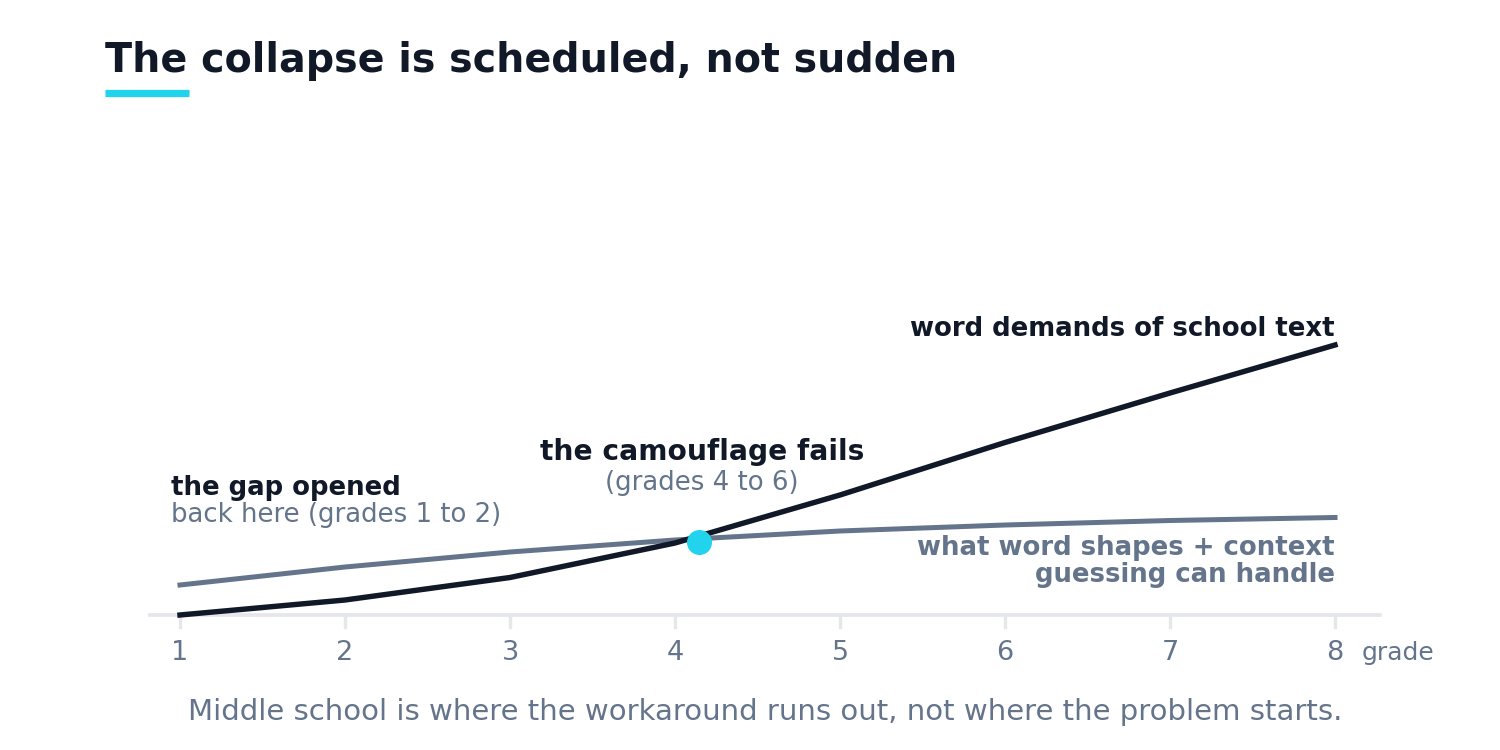
The actual timeline runs differently. For many of these students, the gap opened in first or second grade and has been quietly managed ever since. What changed in middle school is not the student. It is the words. The text used to teach reading is built to be generous to a reader with shaky decoding: short words, familiar words, controlled patterns, pictures, predictable sentences. Grade level text from about fourth grade on is not generous at all. It is dense with long, unfamiliar, academic words that cannot be guessed from context because they are the content.
The problem did not appear in seventh grade. The camouflage failed in seventh grade.
Those are different events, and they call for different responses. The rest of this article walks through the five root causes that produce the pattern, because once you can see the machinery, the student stops looking mysterious and starts looking teachable.
The five root causes at a glance:
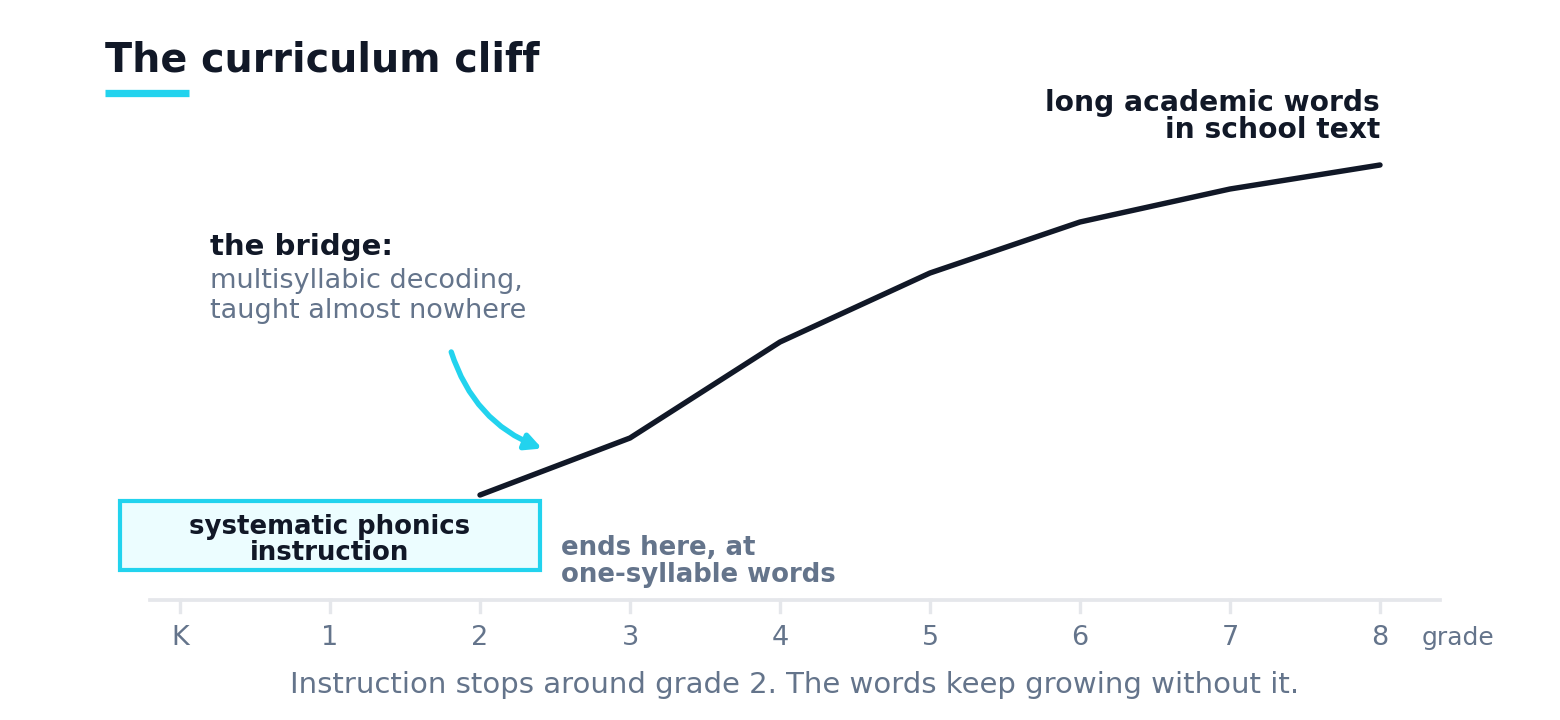
- The curriculum cliff. In practice, phonics instruction usually winds down around grade 2, at one-syllable words, while the words keep growing.
- One-syllable skills do not scale. Letter-by-letter sounding out overflows working memory on long words.
- Schwa and stress break the rules. Faithfully applying the rules they learned produces wrong pronunciations.
- Compensation hides it. Memorized word shapes and context guessing pass for reading until grades 4 to 6.
- The avoidance spiral. Reading avoided is practice never accrued, and the gap compounds every year.
Root cause 1: the curriculum cliff
Walk into most schools and you will find the same unwritten rule: phonics is a K-2 subject. On paper, the standards carry decoding further; grade 3 standards include multisyllabic words. In practice, the daily, systematic instruction usually winds down around second grade, at one-syllable words. Short vowels, blends, vowel teams, silent e. I say this as someone who taught in those classrooms and then coached across many more of them, not from a national dataset, and it is the most consistent pattern I saw.
Here is the part that keeps the cliff invisible: word instruction does not stop after second grade. It changes layers. From third grade on, word work mostly means vocabulary study: what words mean, their roots, how to use them in a sentence. Morphology can serve double duty, since prefixes and roots help with pronunciation too, but the routine for actually reading an unfamiliar long word goes untaught. And because students keep getting lessons about words, everyone operates on the assumption that word reading is finished business. The shift is so standard that nobody experiences it as a decision anyone made.
Meanwhile the words keep growing. From fourth grade on, students meet an enormous wave of new vocabulary in print, and the words that carry academic meaning are overwhelmingly multisyllabic: environment, independence, revolutionary, photosynthesis. Reading those requires skills nobody taught: peeling off prefixes and suffixes, chunking a base into parts, handling vowel sounds that shift with stress. That is a real curriculum, and in most schools it simply does not exist. Explicit decoding instruction stops at the one-syllable shoreline and the texts sail on without it.
I want to be honest about my own seat in this. As a fifth grade teacher I was trained, like most upper elementary and secondary teachers, to teach content and comprehension. Nobody taught me how to teach a student to take apart constitutional, and for longer than I like to admit, it did not occur to me that this was a thing that had to be taught. When a fifth grader stumbled through long words, I reached for the tools I had: more comprehension strategy, more vocabulary front-loading, more encouragement. The tools were fine. They were aimed at the wrong layer.
The district phonics class is what changed that for me. I signed up expecting to learn how to teach phonics. What I actually learned was phonics, as a reader. I was circling prefixes and chunking bases with the same strategies my students needed, and feeling for myself how much of that work skilled readers do invisibly, which is exactly why nobody thinks to teach it. Most teachers of older students are standing where I stood before that class, and it is a training gap, not a dedication gap.
So the first root cause is the simplest and the least discussed:
The student did not fail to learn the skill. The skill was never in his pacing guide.
Root cause 2: one-syllable skills do not scale
The phonics these students did get taught them to sound words out letter by letter, left to right. That strategy works beautifully at the length it was built for. Stretched across a twelve-letter word, it falls apart, and the falling apart is mechanical, not motivational.
Sound out shade and you are blending three sounds while holding them in mind. Sound out independence the same way and you are juggling a dozen letters' worth of sounds and decisions in a system that comfortably holds only a handful of pieces at once. By the time the student reaches the end of the word, the beginning is gone. Watch a struggling older reader attack a long word letter by letter and you can see the exact moment the load tips over: they restart, restart again, then quit and guess.
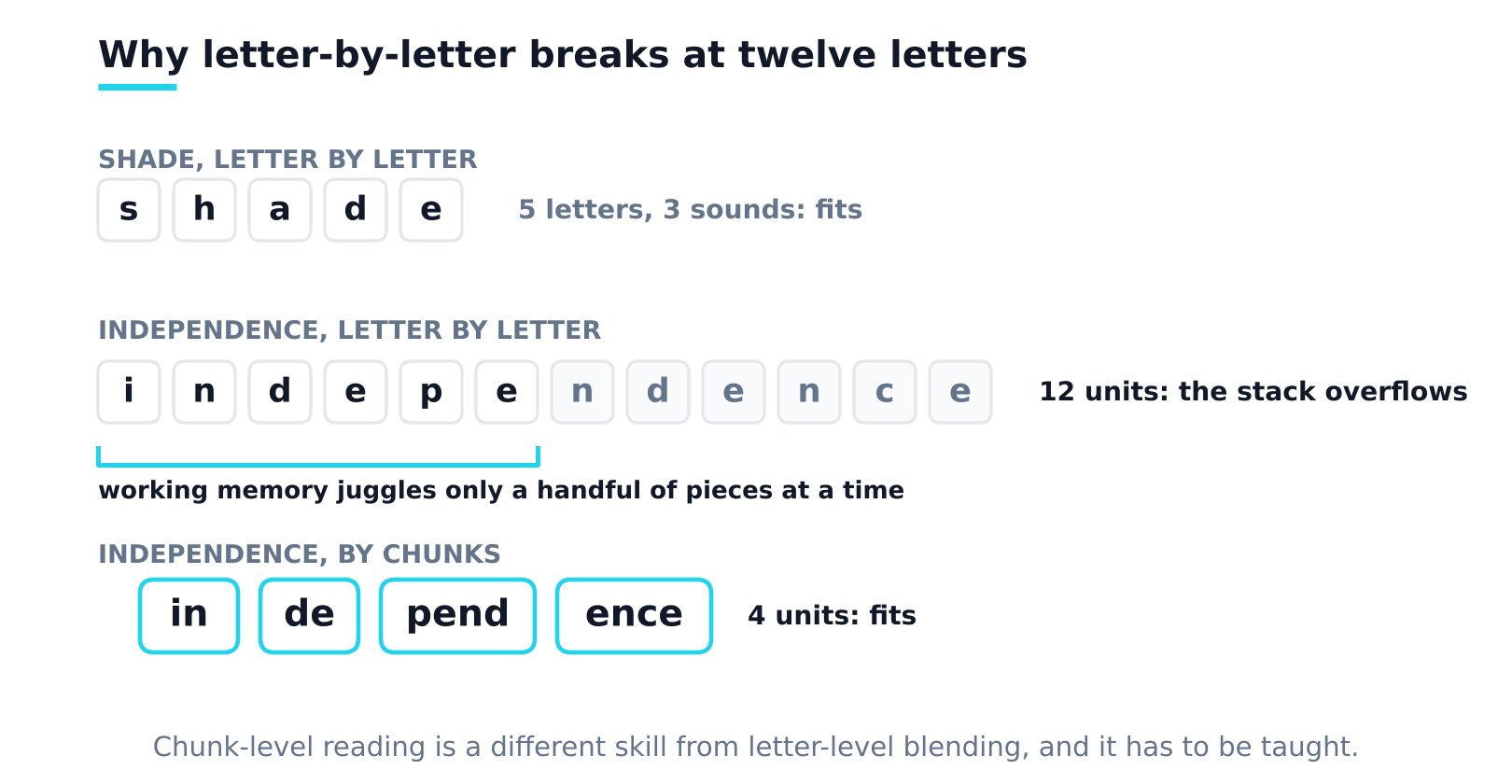
Skilled readers do not read long words sound by sound. They read them in chunks: a prefix, a familiar spelling pattern, a suffix, three or four units instead of twelve. Chunk-level reading is a different skill from letter-level blending, the same way reading music by phrases is different from naming every note.
Letter-level practice alone rarely produces chunk-level reading. It has to be taught.
Root cause 3: schwa and stress break the rules they learned
There is a second structural betrayal inside long words. In English, multisyllabic words carry stressed and unstressed syllables, and vowels in unstressed syllables often reduce to a relaxed "uh" sound called schwa. The o in lesson. The a in about. The first e in independence.
Now consider the student who learned clean letter-sound rules and applies them faithfully. Faithful application produces the wrong word: a-BOUT with a long a, les-SON with a clear o. The rules they were taught are not wrong. They are one-syllable rules, and long words run on an additional system of stress and vowel reduction that nobody mentioned. The student who says "pro-CLAM-ation" and moves on is not being careless.
He has no procedure for a wrong first attempt, because nobody ever told him a first attempt could be a draft.
That procedure exists, and I wrote the step-by-step walkthrough, teaching script included, in The Flexible Strategy: How to Teach Big-Word Decoding Step by Step.
Root cause 4: compensation hides it for years
A bright student with weak decoding does not sit still and fail. He builds workarounds, and the workarounds are genuinely clever: go by a word's overall look and length, use the first letters plus context to guess the rest, lean on pictures, listen hard during discussion and reconstruct the text from what everyone else said.
Through third grade, that toolkit works. Elementary text is exactly the environment it was built for, and the student can look like a grade level reader on the strength of it. Reading researchers have long described this kind of compensation: readers with weak decoding leaning on context and partial cues to get by (Share and Stanovich, 1995). The classroom version is the student who sails through a list of familiar words and then sinks in a textbook full of unfamiliar ones.
For many students, somewhere in the fourth to sixth grade window, the word density of school text outruns the strategy. There are suddenly too many long words to memorize as shapes, and context cannot supply a word like photosynthesis because the word is the thing being taught.
This is what I was watching in my fifth grade classroom in those first Octobers, without having the frame to name it: not students losing a skill, but a compensation system hitting its ceiling in real time. As a coach I then saw the same ceiling, at the same grades, in classroom after classroom. The consistency is the tell.
When the same collapse shows up on schedule across buildings, you are not looking at individual failure. You are looking at structure.
Root cause 5: the avoidance spiral, and what students decide it means
Reading that feels this effortful gets avoided, quietly and rationally. And because word reading becomes automatic through volume, through thousands of successful encounters with print, every avoided page is practice that never happened. The gap compounds annually. By seventh grade the student has not just missed instruction; he has missed years of mileage.
Reading research has a name for this dynamic: the Matthew effect, Keith Stanovich's (1986) term, borrowed from the line about the rich getting richer. Students who read easily read more, and the volume makes them even stronger readers. Students who struggle read less, and the avoidance makes the struggle worse. The spiral below is not a metaphor. It is one of the most documented patterns in reading research.
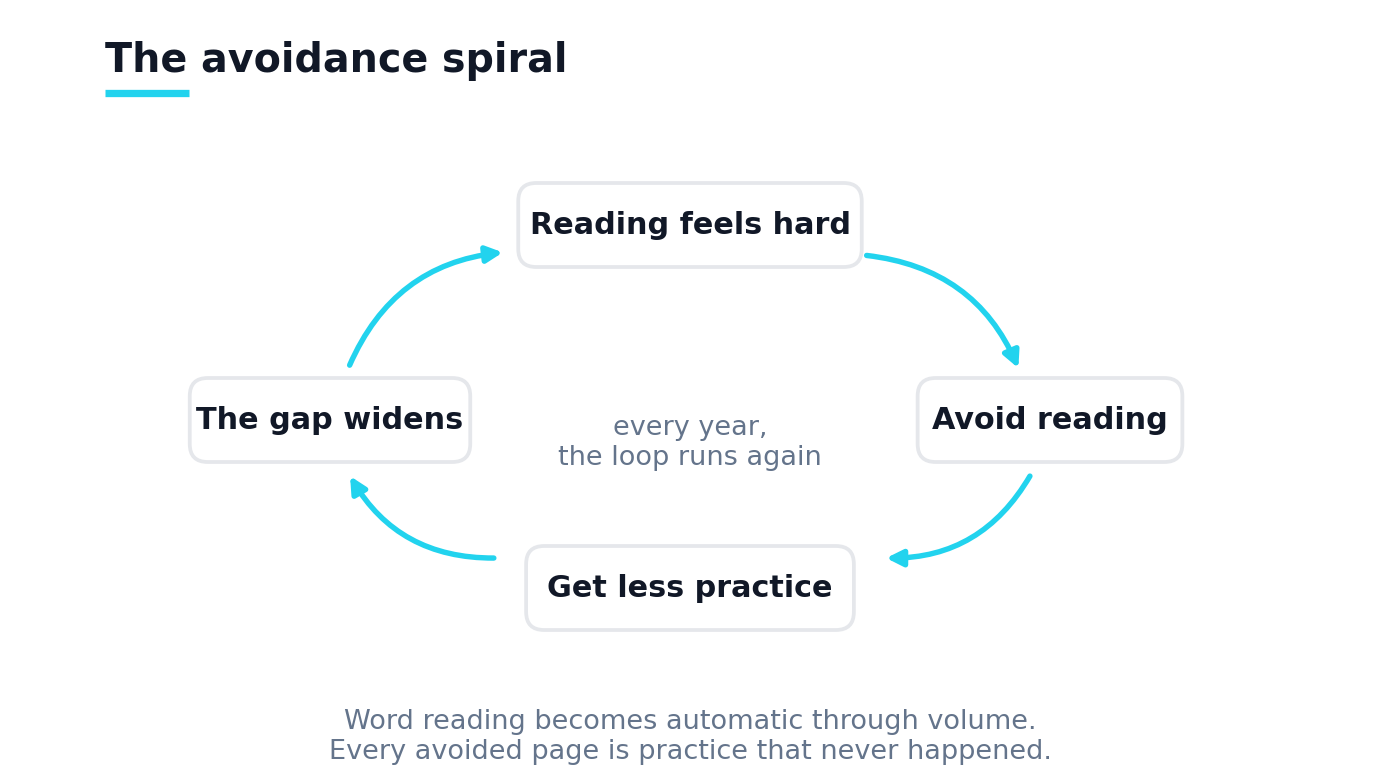
Here is the part that changed how I talk to students about it. They do not experience any of this as "I need phonics." They have no access to the cause. What they experience sounds like this:
- "Reading takes me forever."
- "I hate reading out loud."
- "I can read it, but I don't really get it."
And when reading has been hard for as long as they can remember, many of them do not even know it is hard, because they assume their experience is everyone's experience. They think effort is what reading is.
So they fill in the blank with the only explanation available: "I'm bad at reading. I'm not a reader. I'm dumb."
A skill gap, left unnamed for five years, quietly converts into an identity.
That is why the same classroom holds the student who shrugs and the student who simmers. In my experience the apathy is often protection, since you cannot fail publicly at something you refuse to try, and the frustration is often readiness waiting for work that looks credible. I wrote more about this awareness gap, and what teachers told me about it, in They Don't Know It's Phonics.
What actually helps
The good news hiding inside all five root causes: nothing here describes a student who cannot learn. Most of what these root causes describe was never taught or never practiced, and the intervention research on struggling readers in grades 4 through 12 shows that word-level instruction still moves the needle for older students (Scammacca et al., 2015). Some students will need more intensive support than a classroom teacher can provide alone, and that is what referral processes are for. For everyone else, the shape of the response follows directly from the causes.
Name it for the student, in plain language. The single cheapest intervention is clarity. Something like: this is a skill, not a trait; reading feels hard because your brain is working too hard on the words, especially long ones; we are going to practice breaking words into parts so you do not have to guess. In my experience, students who understand that the difficulty has a specific, addressable source persist differently than students who believe it is their brain. Not because of a pep talk, but because the work finally looks credible.
Diagnose before you intervene. Confirm the problem is actually word-level before spending intervention time on it. Ten minutes with a short word list and a few nonsense words gives you a strong first read; the full procedure is in the complete guide to phonics intervention for middle and high school, and the free Decoding Spot-Check printable packages it. If you want a systematic version, Juniper Navigate is a free phonics screener you can run in about 15 minutes.
Teach a routine for long words, not a rule system. The fix for root causes 2 and 3 is a single flexible strategy: peel the affixes, chunk the base by its vowels, read it by parts, then flex the vowels and stress until a real word appears. Explicitly teaching students to decode multisyllabic words is also the recommendation with the strongest evidence rating in the federal practice guide for reading intervention in grades 4 to 9 (Institute of Education Sciences, 2022). The step-by-step version, with a teaching script, is in The Flexible Strategy: How to Teach Big-Word Decoding Step by Step.
Then build mileage. Root cause 5 only reverses through volume: accurate reading, in real text, every day, in conditions that do not humiliate. Skills first, then miles.
This gap is the one I eventually built a career around closing: first teaching that phonics class to teachers across my district, and now building Juniper Decode, a practice app that gives older students short, age-respectful daily lessons in multisyllabic decoding and morphology. I am piloting it with teachers right now. It exists because of the students in this article, but nothing above requires it; a whiteboard and fifteen minutes a day are enough to start.
Frequently asked questions
Why can't my 7th grader read long words?
For many of these students, the gap opened in first or second grade and has been quietly managed ever since. What changed in middle school is not the student. It is the words.
Is it a motivation problem?
Stretched across a twelve-letter word, it falls apart, and the falling apart is mechanical, not motivational.
What is the Matthew effect in reading?
Reading research has a name for this dynamic: the Matthew effect, Keith Stanovich's (1986) term, borrowed from the line about the rich getting richer. Students who read easily read more, and the volume makes them even stronger readers. Students who struggle read less, and the avoidance makes the struggle worse.
What can I do tomorrow?
You will not need a new curriculum or an extra prep period. A whiteboard and tomorrow's class are enough.
References
Ehri, L. C. (2014). Orthographic mapping in the acquisition of sight word reading, spelling memory, and vocabulary learning. Scientific Studies of Reading, 18(1), 5-21.
Institute of Education Sciences. (2022). Providing reading interventions for students in grades 4-9 (WWC 2022007). What Works Clearinghouse, U.S. Department of Education. https://ies.ed.gov/ncee/wwc/PracticeGuide/29
Scammacca, N. K., Roberts, G., Vaughn, S., & Stuebing, K. K. (2015). A meta-analysis of interventions for struggling readers in grades 4-12: 1980-2011. Journal of Learning Disabilities, 48(4), 369-390.
Self, G. (2026). They don't know it's phonics, and the real secondary reading gap is word-level. Juniper Consulting. https://www.juniperconsultingllcwa.com/articles/secondary-reading-gap-is-word-level
Share, D. L., & Stanovich, K. E. (1995). Cognitive processes in early reading development: Accommodating individual differences into a model of acquisition. Issues in Education, 1(1), 1-57.
Stanovich, K. E. (1986). Matthew effects in reading: Some consequences of individual differences in the acquisition of literacy. Reading Research Quarterly, 21(4), 360-407.
By Genevra Self, Juniper Reading CoLab. Free to print and share with your team. juniperreadingcolab.com
https://www.juniperreadingcolab.com/articles/why-older-students-get-stuck-on-multisyllabic-words