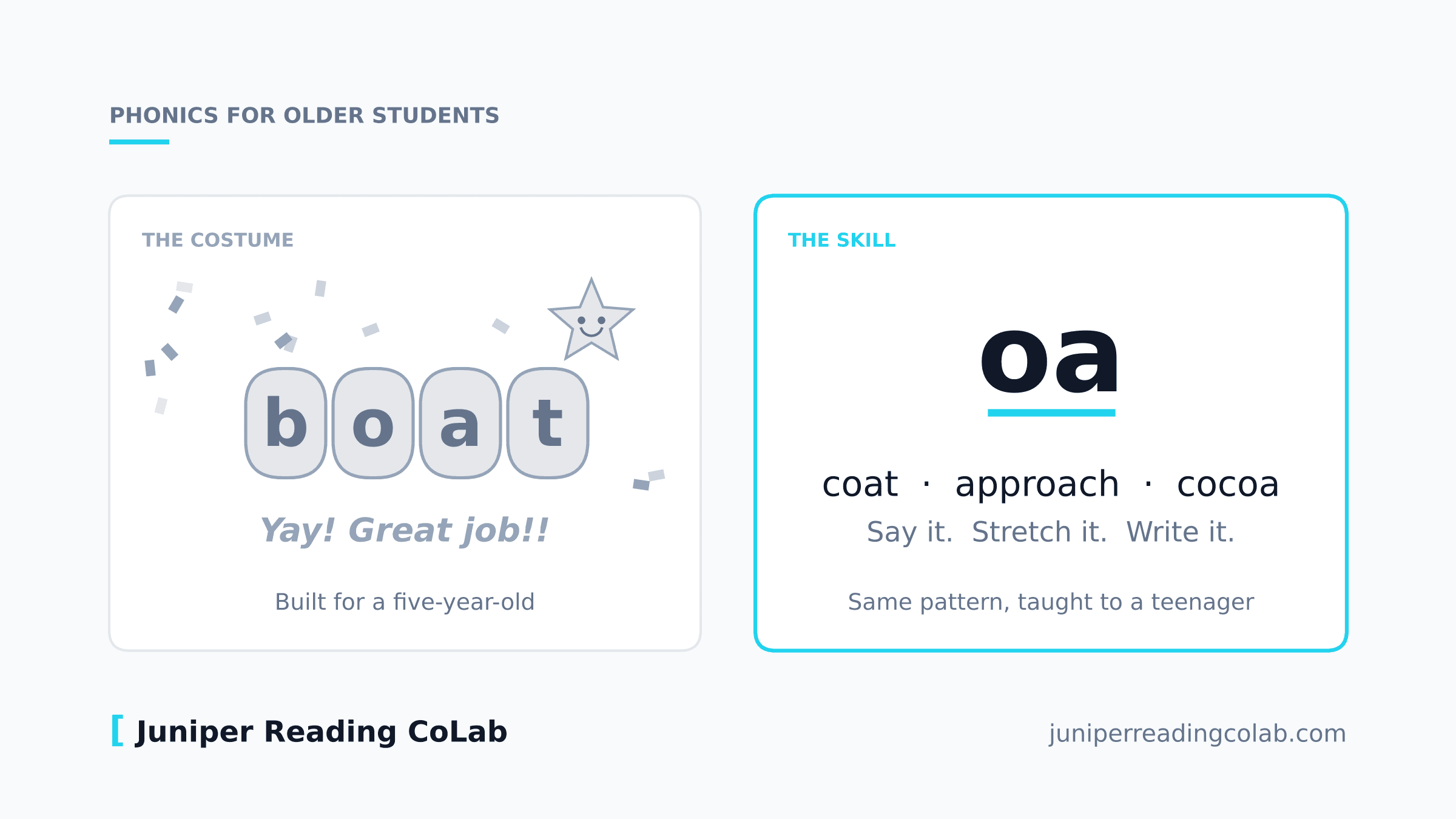
A high school student sits in study hall with a laptop open to his assigned lessons. A diagnostic test found gaps in his phonics, so the software gave him lessons to fill them. The lessons were built for kindergartners. A cartoon character walks him through short vowel sounds. A video narrator talks to him the way you would talk to a five-year-old. When he gets an answer right, the screen explodes in confetti.
He is a teenager in a room full of other teenagers, and the lessons were so embarrassing that he refused to do them at all.
For ten months I worked as an implementation manager for an edtech startup. The platform matched specific lessons in different apps to the specific learning gaps students showed on their assessments, so each student got only the lessons they needed. My job was to support schools in implementing it, so I spent a lot of time in schools, watching students use it. Like most things in education that involve technology, the reality was different from what was sold. When middle and high school students had phonics gaps, the lessons the system assigned them were plainly made for kindergarten and first grade.
That high school student was not the only one. In other middle and high schools using the platform, I watched many students with phonics gaps do the same thing he did: they stopped. Teachers and school leaders kept asking me the same question. Is there something more age appropriate we can assign? I took the question to the company's academic team. They had looked, and the answer was no. The district leaders had looked too, and told me the same thing.
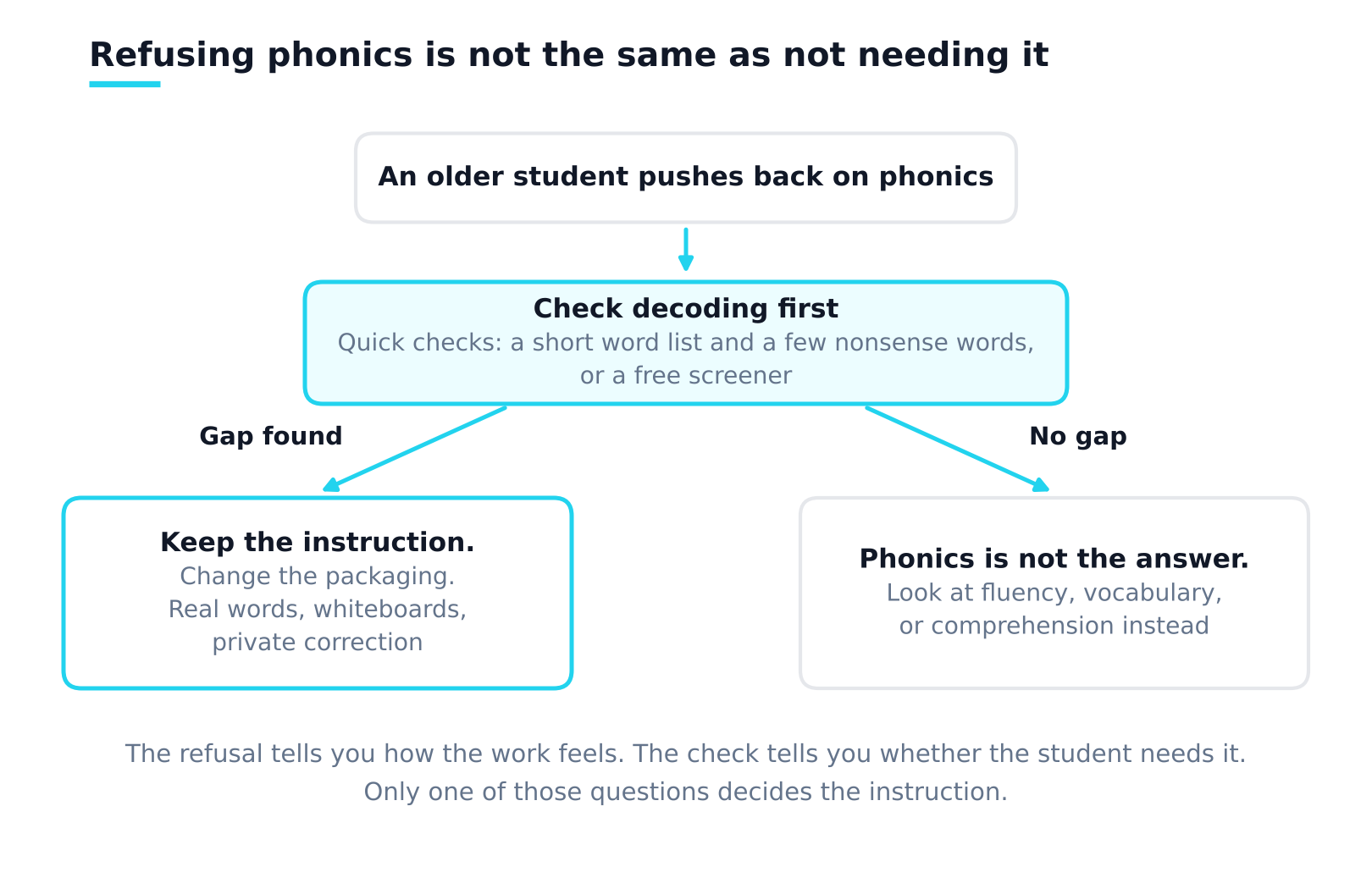
Here is what I took from watching it happen. Those students did not refuse phonics. They refused to be treated like little kids in front of their peers. Those are two different problems, and only one of them means the student does not need the instruction.
This article is about telling those two problems apart, and about teaching decoding to older students in a way they will actually do.
Why the refusal makes sense
When an older student pushes back on phonics, it is easy to read it as attitude: he does not want to work, he thinks he is too good for it, he has given up. Usually it is something more reasonable than that. He is protecting his dignity.
Think about what a phonics gap means to a teenager. He has spent years hiding that reading is hard for him, often successfully. Now an adult hands him materials that announce, to him and to anyone looking over his shoulder, that he reads like a little kid. Refusing is one of the few moves he has left that keeps his reputation intact. Other students go quieter: they pretend to work, rush through, or find a reason to be somewhere else.
That changes what you are trying to fix. The problem is usually not that he does not need decoding instruction. The problem is that the instruction comes packaged for a much younger child. Changing how instruction is presented can remove one important reason older students resist it. It does not remove every barrier, but it gives students a better chance to engage with the instruction they need.
Embarrassment is not the only reason older students push back. Some have sat through years of reading help that never worked. Some find the work too hard, too easy, or disconnected from anything that feels like progress. Those reasons need their own answers. But when the materials look like they were made for a five-year-old, that one reason is easy to remove, and it is worth removing first.
A useful comparison: an adult who never learned to swim does not want lessons in the toddler pool with inflatable armbands. He still needs to learn the same strokes. He needs to learn them in the adult lane.
What makes phonics feel babyish
The skill is not what makes phonics feel babyish. A sixteen-year-old and a six-year-old who both cannot read the vowel team oa need to learn the same thing. What feels babyish is the packaging around it. Here are the signals older students notice, and what to use instead.
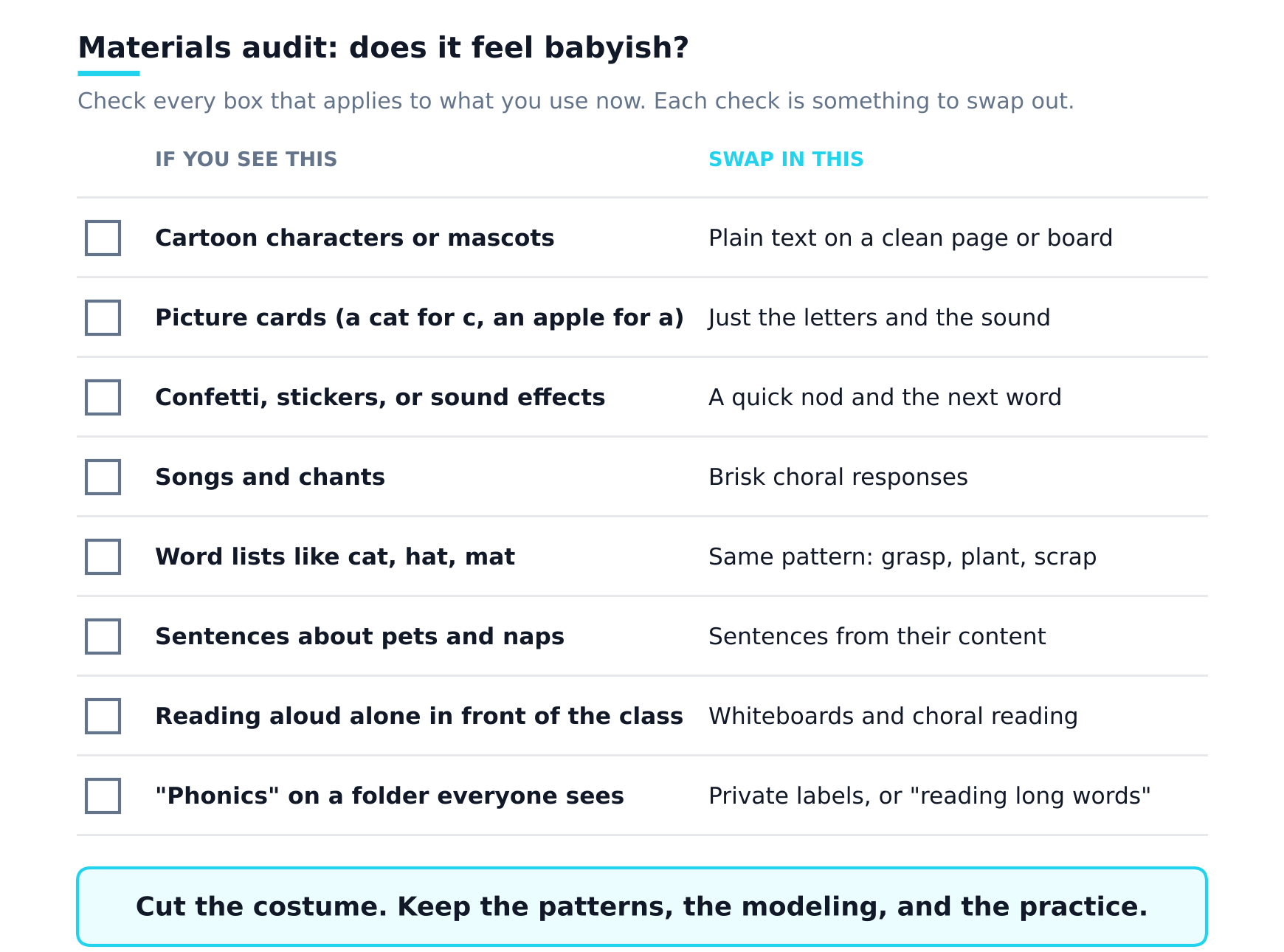
| What students notice | Why it stings | What to use instead |
|---|---|---|
| Cartoon characters and mascots | Says "this was made for little kids" | Plain text on a clean page or board |
| Picture cards (a cat for c, an apple for a) | The first-grade signal everyone recognizes | The letters and the sound, nothing else |
| Confetti, stickers, sound effects for right answers | Turns a skill into a toddler game | A quick nod and the next word |
| Songs and chants | Feels like circle time | Brisk choral responses: "Say it. Stretch it. Write it." |
| Word lists like cat, hat, mat | Reads like a picture book | Words with the same pattern that don't, such as grasp, scrap, plant |
| Sentences about pets and naps | Talks down to them | Sentences from their content: science, history, sports, current events |
| Reading aloud alone in front of the class | Public exposure of the weakest skill | Whiteboards and choral reading, so nobody performs solo |
| "Phonics" written on a folder everyone can see | A public label they can be teased about | Keep labels private, or name it by its purpose: "reading long words" |
Notice what stays the same in the right-hand column: the letter-sound patterns, the explicit modeling, the practice, the spelling. Nothing about age-respectful instruction is easier or vaguer. It is the same skill, taught without the costume.
One caution: age-respectful does not mean skipping ahead. A student who still needs short-vowel work needs short-vowel words, not membrane because it looks more grown-up. Choose words that practice the pattern the student actually needs without sounding like a picture book. When the student's skills are ready, move to longer words broken into parts, the way the Flexible Strategy and the word part routine do. From then on, the work looks like high school because it is high school work.
How to frame the work for students
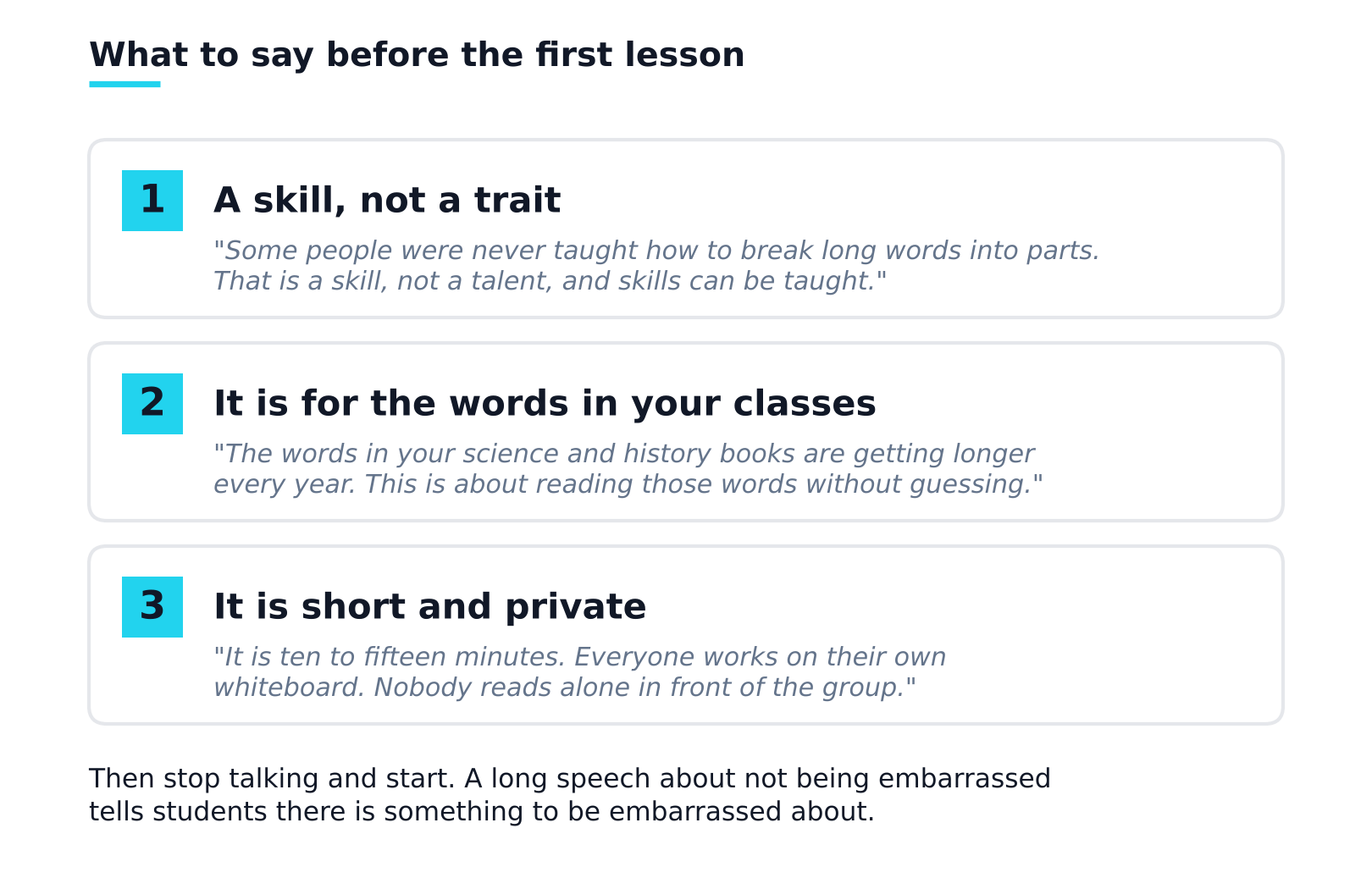
How you introduce the work decides whether students hear "you are behind" or "here is a tool." Three things to say, in plain language, before the first lesson.
Name it as a skill, not a trait.
"Some people were never taught how to break long words into parts. That is a skill, not a talent, and skills can be taught. We are going to practice it a few minutes a day."
Connect it to what they are reading now.
"The words in your science and history books are getting longer every year. This is about reading those words without guessing."
Tell them how short and private it is.
"It is ten to fifteen minutes. Everyone works on their own whiteboard. Nobody reads alone in front of the group."
Then stop talking and start. A long speech about how there is nothing to be embarrassed about tells students there is something to be embarrassed about. The fastest way to make the work feel normal is to do it briskly, the same way, every day.
When a student refuses, start by checking the student's skill level, then look at how the lesson is presented, talk with the student privately, and offer a starting point that is challenging but doable.
If a student still pushes back, offer a trade instead of a lecture: "Show me you can read these five words accurately, and we will move to harder ones." Students who can do it earn the faster pace. Students who cannot usually accept the practice once the choice was theirs.
Routines that keep mistakes private
For an older student, the worst part of decoding practice is not the work. It is being wrong where people can see. Build the routine so errors are small, quick, and private.
- Whiteboards, not paper. A whiteboard answer lives for ten seconds and gets erased. Nothing is collected or graded, which tells students this is practice, not evidence against them.
- Choral first, then individual. The group reads a word together before anyone reads alone. A student who is unsure can listen once, then try.
- Check each student privately, too. Choral reading protects students, but it also lets a student follow the group without reading the word. Build in quick one-on-one checks: while the group writes, one student reads three words quietly to you.
- Correct the pattern, not the person. Say "the middle sound is the vowel team o-a," not "Marcus, look at yours again." Every student fixes their own board.
- Watch the boards, not the faces. You find out who needs what without anyone else knowing.
- Keep it short and every day. Ten to fifteen minutes, the same steps each time. A routine that never changes stops feeling like a spotlight.
- Never read the weakest skill aloud alone. Solo reading aloud is the single most public moment in a lesson. Save it for text the student can read well, or skip it.
A note on time: ten to fifteen minutes is a daily practice routine, not the total intervention every student needs. Students with large decoding gaps often need more intensive instruction than a short daily routine can give.
If you want the full lesson structure these routines fit into, it is in the complete guide to phonics intervention for middle and high school.
"Phonics doesn't belong past second grade"
You may have heard that phonics doesn't belong past second grade. The argument usually goes like this: phonics is for little kids, older students already know their letter sounds, and drilling them wastes time and kills their interest in reading. It is worth taking seriously, because parts of it are right.
What the argument gets right.
- Most of the research on phonics comes from kindergarten and first grade, and that is where the effects are largest.
- Many older struggling readers do not have a decoding problem at all. For them, phonics really is a waste of time.
- Drill for its own sake, disconnected from real reading, does not make students better readers. And babyish drill drives them away, as the students in my opening showed. The alternative is a routine students apply to the long words in their own classes, like the Flexible Strategy.
- Older students need lots of reading in texts they can read and want to read.
What it gets wrong. It treats "most older students do not need phonics" as if it meant "no older student needs phonics." Some older students cannot decode accurately, and nothing else works until they can.
The current evidence says to find those students and teach them directly:
- The Institute of Education Sciences practice guide for grades 4 to 9 gives a strong evidence rating to building students' ability to decode complex multisyllabic words (IES, 2022).
- Reading researcher Timothy Shanahan, who is cautious about phonics in the upper grades, still advises teachers to "be on the lookout for kids who are not able to decode proficiently," and says those students "need a dedicated, explicit phonics intervention in addition to anything else you can provide" (Shanahan, 2024).
Shanahan is also honest about the limits: "we don't know much about how best to teach decoding in grades 2-12." That is a fair warning, not a reason to skip it. It means checking which students actually need decoding work, keeping the instruction tied to the words they read in class, and watching whether it carries into their reading.
One more distinction worth making. The research supports teaching decoding to older students who need it. It has not tested whether removing confetti or switching to whiteboards gets more students to participate. That advice comes from what I saw in classrooms and schools, and it should be read that way: professional experience, not a study.
So the answer is not phonics for everyone, and not phonics for no one. It is decoding instruction for the students who need it, delivered in a way that respects their age. The students in my opening did not need less instruction. They needed instruction that did not treat them like five-year-olds.
Not sure which of your students have a decoding gap? The three quick checks in the complete guide will sort them, or you can use Navigate, a free phonics screener that takes about 15 minutes.
What to do tomorrow
- Audit your materials. Hold up whatever you use for decoding practice and check it against the table above. Cut the cartoons, picture cards, and confetti. Keep the patterns.
- Swap in their words. Replace one word list with words from this week's science, history, or ELA reading.
- Say the three framing lines before your next session: a skill, not a trait; it is for the words in your classes; it is short and private.
- Put whiteboards in their hands. Run the next practice on whiteboards with choral reading first, and correct the pattern, not the person.
- Watch the student who refused. Notice whether he works when the signals change. If he does, you have your answer about what the refusal was really about.
The teachers and leaders in my story kept asking for something more age appropriate, and nobody could find one. Those questions are a big part of why I later built Juniper Decode, a phonics program designed for students in grades 3 to 12. But you do not need a program to start. A whiteboard, real words, and a routine that respects your students' age will get most of them working tomorrow.
Frequently asked questions
Why do older students think phonics is babyish?
The skill is not what makes phonics feel babyish. A sixteen-year-old and a six-year-old who both cannot read the vowel team oa need to learn the same thing. What feels babyish is the packaging around it.
Should middle and high school students be taught phonics?
So the answer is not phonics for everyone, and not phonics for no one. It is decoding instruction for the students who need it, delivered in a way that respects their age.
How do I make phonics age appropriate for older students?
Changing how instruction is presented can remove one important reason older students resist it. It does not remove every barrier, but it gives students a better chance to engage with the instruction they need. Nothing about age-respectful instruction is easier or vaguer. It is the same skill, taught without the costume.
What should I do when an older student refuses phonics?
When a student refuses, start by checking the student's skill level, then look at how the lesson is presented, talk with the student privately, and offer a starting point that is challenging but doable. If a student still pushes back, offer a trade instead of a lecture: "Show me you can read these five words accurately, and we will move to harder ones."
References
- Institute of Education Sciences, What Works Clearinghouse. (2022). Providing Reading Interventions for Students in Grades 4-9 (WWC 2022007). ies.ed.gov
- Shanahan, T. (2024, January 6). Does the science of reading include middle school? Shanahan on Literacy. shanahanonliteracy.com
By Genevra Self, Juniper Reading CoLab. Free to print and share with your team. juniperreadingcolab.com
https://www.juniperreadingcolab.com/articles/phonics-older-students-not-babyish