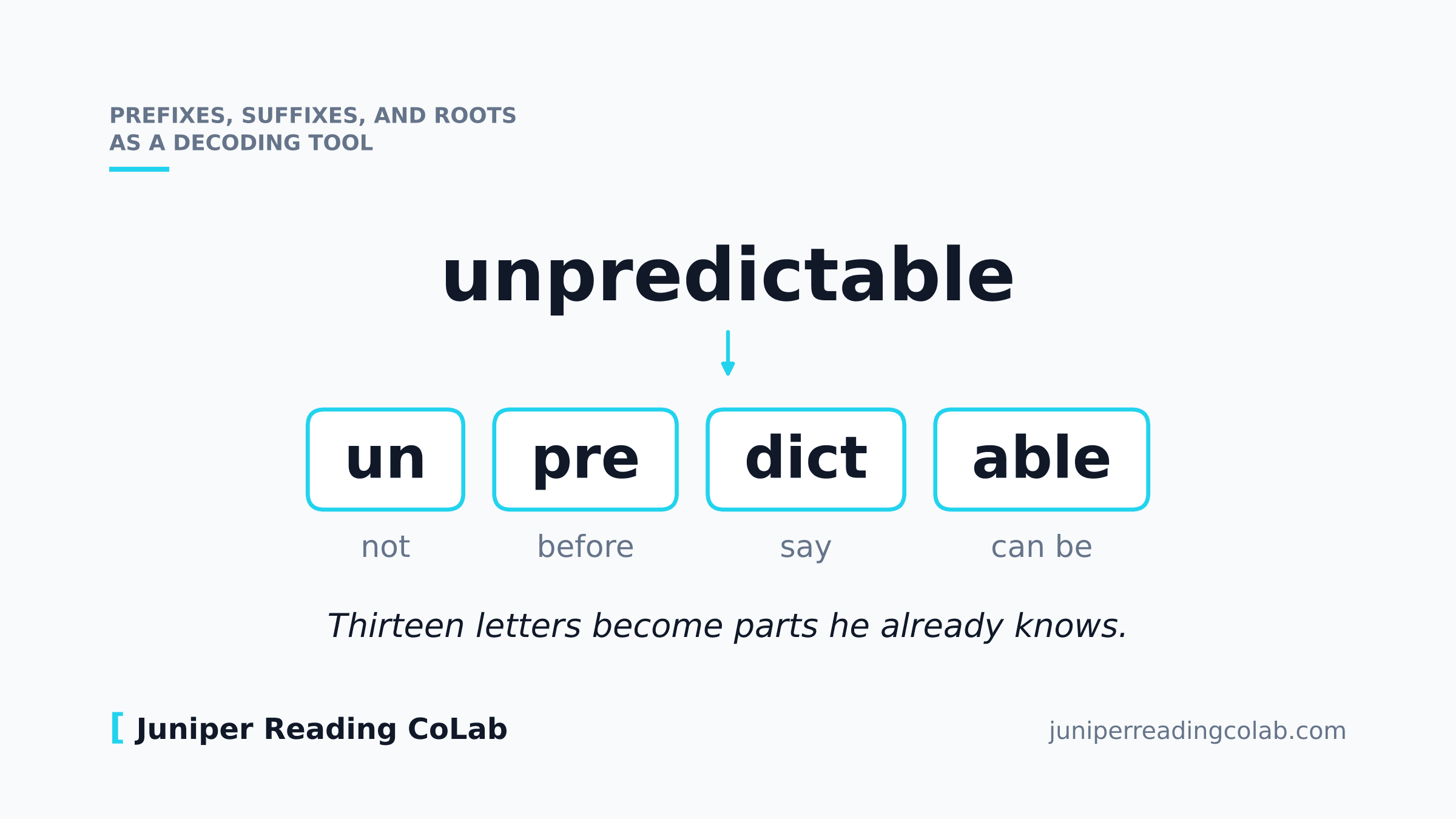
He can read un. He can read predict; you heard him say it during the science warm-up. He would tell you able means you can do something. Then the paragraph says the weather pattern was unpredictable, and he stops cold. He says "un... un-pred...", glances at you, and lands on "unbelievable."
He knew every piece of that word. What he could not do was see the pieces inside it.
That is the gap this article is about. Most of us were taught that prefixes, suffixes, and roots belong to vocabulary: a list on Monday, a quiz on Friday, a few meanings to memorize. For a student who cannot read long words, they do something more urgent. They are the chunks that turn a thirteen-letter wall into three parts he already knows. This article shows you how to teach them that way, with a five-minute routine you can start tomorrow.
If you have already read the Flexible Strategy, the big-word routine from the REWARDS program (Archer, Gleason, and Vachon, 2006), you know that step one is circling the prefixes and suffixes. This article is about what comes before that step and around it: how students learn to spot word parts on sight, what to do with the roots in the middle, and how to read the places where the parts join.
Same word parts, different job
Morphology is the study of the meaningful parts inside words: prefixes, suffixes, and roots. The same parts can be taught for two different jobs, and most of what you find online teaches only the first one.
| Taught as vocabulary | Taught as decoding | |
|---|---|---|
| The question students answer | What does this part mean? | Where does this part start and stop, and how does it sound? |
| What practice looks like | Matching pre- to "before" on a worksheet | Spotting pre- inside unpredictable and reading it in one beat |
| What success looks like | Writes the right definition | Reads the long word accurately, then knows roughly what it means |
| Who it helps most | Students who can already read the word | Students who stall on the word in the first place |
The vocabulary job matters, and linking a part's sound to its meaning gives students another chance to learn it. But for a student who cannot read unpredictable, a definition of pre- does nothing until he can find pre- inside the word. For a student who stalls on long words, start with decoding: finding the part and reading it. Meaning can come along with it.
It works like a phone number. Ten digits in a row, 5035550147, are hard to hold in your head. Split them into 503, 555, 0147 and the same digits suddenly fit. Word parts do that for long words: unpredictable stops being thirteen letters and becomes un, predict, able.
What the research says
Teaching word parts can help students read and spell words, not only define them. The evidence is clearest for words students practice directly; carrying that skill to brand-new words in reading is less certain, so it has to be taught on purpose.
- It can improve decoding and spelling. A meta-analysis of 30 morphology studies with school-age students found significant effects on decoding and on spelling, along with vocabulary (Goodwin and Ahn, 2013).
- Struggling readers can benefit. A review of 22 studies, from preschool through grade 8, found positive effects of morphology instruction, with larger effects for less able readers (Bowers, Kirby, and Deacon, 2010).
- It worked best inside reading instruction. In a review of 17 studies of students with literacy difficulties, morphology taught as part of broader reading instruction showed significant effects; taught on its own, it did not. In that review, programs shorter than about 10 hours of instruction also did not show significant effects, and the effect on decoding specifically was small (Goodwin and Ahn, 2010).
- Transfer to new words has to be built. A 2024 meta-analysis of 28 studies with elementary students found clear gains on the words students practiced. Students also spelled new, untaught words better, but there was no clear evidence that they read new, untaught words better (Colenbrander and colleagues, 2024).
- Multisyllabic decoding is a federal priority. The Institute of Education Sciences practice guide for grades 4 to 9 gives its strongest evidence rating to building students' ability to decode complex multisyllabic words. That rating covers decoding instruction broadly, not one specific morphology routine (IES, 2022).
What this means in your classroom: teach word parts as part of reading the word, practice each part in many different words, and keep asking students to use the parts on words they have never practiced, in real text. The five-minute routine below is one way to do that. It is a practical suggestion informed by this research, not a separately tested program.
One honest limit: most of these studies are with elementary and middle school students. Research with high school students is thinner, so watch whether your students carry the parts into new words, and adjust.
Which parts to teach first
You do not need a book of 300 roots. A small set of common parts shows up across a huge number of long words, so teach the high-payoff ones first, a few at a time.
Start with the prefixes and suffixes students see most
Among words that have a prefix, four prefix groups, un-, re-, in-/im-/il-/ir-, and dis-, account for more than half (White, Sowell, and Yanagihara, 1989). Un- alone covers about a quarter. Start there.
The full starter list of 10 prefixes and 10 suffixes, with meanings, is in the Flexible Strategy article. Use that list for your first few weeks.
Then add the roots that live in your content
Roots are where content-area teachers have an edge. The long words in science and history are built from a small number of Latin and Greek parts, and you already teach the words that use them.
Latin roots: usually the middle of the word, often with a prefix in front and a suffix behind.
| Root | Meaning | Words students meet |
|---|---|---|
| port | carry | transport, export, portable |
| rupt | break | erupt, interrupt, disruption |
| struct | build | structure, construction, instructor |
| tract | pull | tractor, subtract, attraction |
| spect | look | inspect, spectator, perspective |
| dict | say | predict, dictate, contradiction |
| scrib, script | write | describe, transcript, prescription |
| ject | throw | project, reject, injection |
Greek forms: common in science, often stacked two or three together.
| Form | Meaning | Words students meet |
|---|---|---|
| photo | light | photograph, photosynthesis |
| graph | write, draw | biography, paragraph, graphic |
| bio | life | biology, antibiotic |
| geo | earth | geography, geology |
| therm | heat | thermometer, hypothermia |
| hydro | water | hydrogen, dehydrate |
| chron | time | chronological, synchronize |
| -ology | study of | ecology, psychology |
Greek forms also carry their own spelling clues, and these are decoding gold. Teach students that in Greek words:
- ph says /f/: photo, graph, phase
- ch often says /k/: chron, chlorophyll, character
- y in the middle of a word often says short /i/: system, symbol, hypothesis
A student who knows those three clues can read chlorophyll instead of freezing at chl.
The five-minute word part routine
One word part a day, five minutes, same five moves every time. Sameness is the point: students stop spending energy on what you are asking and spend it on the word. The research does not set one ideal amount of time; this routine is a practical way to fit consistent practice inside your reading time.
| Move | Time | What students do |
|---|---|---|
| 1. Say it | 30 seconds | Hear and repeat the part, its sound, and its meaning |
| 2. Spot it | 1 minute | Find the part in a short word list and read each word |
| 3. Split it | 1.5 minutes | Take one long word apart and read it by parts |
| 4. Build it | 1 minute | Put parts together on whiteboards to make words |
| 5. Write it | 1 minute | Spell two dictated words by parts |
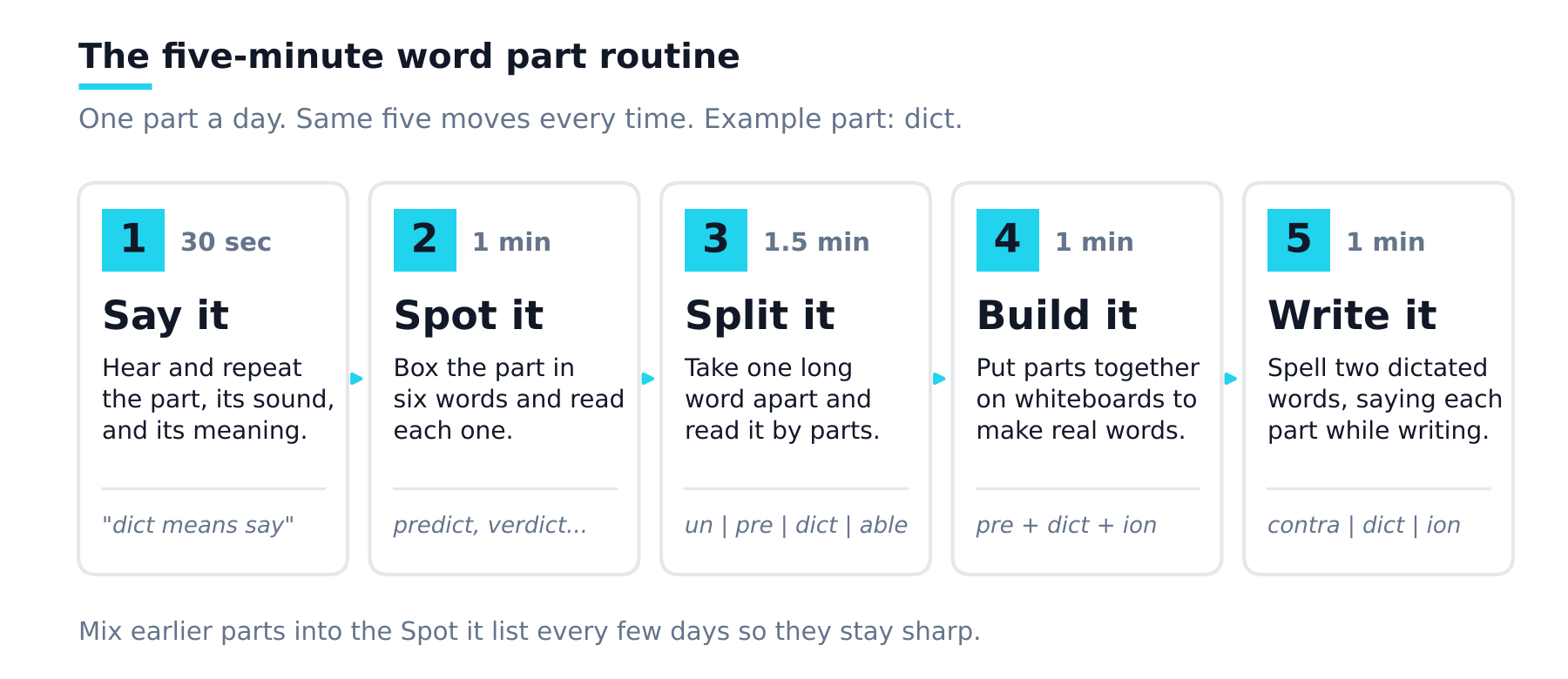
Here is the whole routine on one root, dict, with unpredictable as the long word.
1. Say it
Write dict on the board. "This part is spelled d-i-c-t. It means say. Every time you see these four letters, think say."
Keep it to that. One spelling, one meaning, no list of examples yet.
2. Spot it
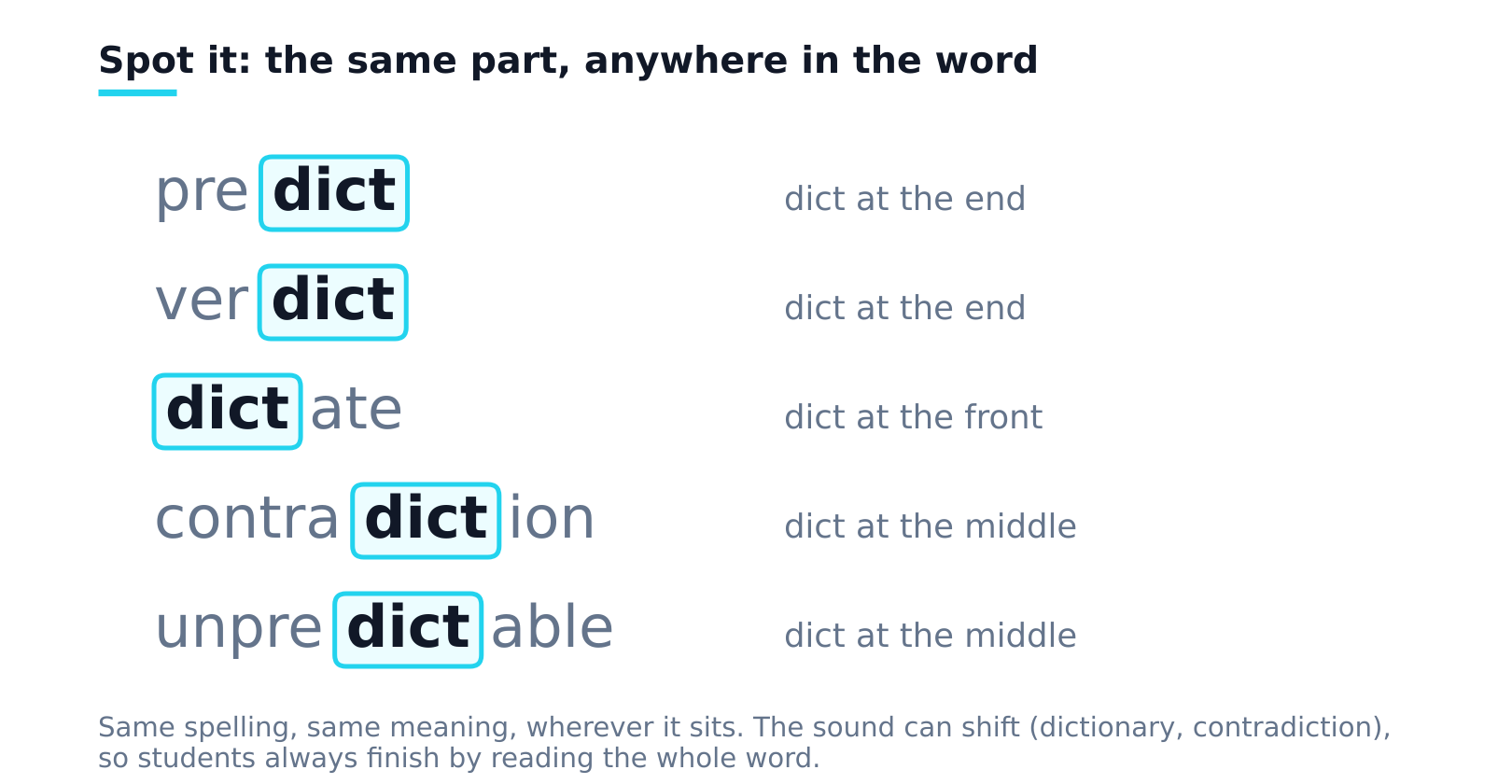
Put up five or six words that contain the part:
predict, verdict, dictate, contradict, dictionary, unpredictable
Students box dict in each word, then read the list together. You are watching for the moment students find d-i-c-t at a glance instead of letter by letter. Notice that the part sits in a different place in nearly every word: front, middle, end. That is on purpose. Students need to find it anywhere.
Point out one more thing: the spelling stays the same, but the sound can shift. In dictionary and contradiction, the t joins the ending and makes a /sh/ sound. That is why every word part routine ends with reading the whole word and checking that it is a real word you know.
3. Split it
Now the long word. Think aloud:
"Unpredictable. Big word, but I bet I know the parts. I look at the front: un. I know that one. Next: pre. Know that one too. Then dict, today's part. At the end: able. So it is un, pre, dict, able. Unpredictable."
Earlier we saw this word as three chunks: un, predict, able. Here predict splits again into pre and dict. Both are right. Start with the biggest chunks a student already knows, and go smaller only when a chunk is still too big to read.
Then add one sentence of meaning, because now it is easy to add: "Not able to say before. If the weather is unpredictable, nobody can say ahead of time what it will do."
This is the same move as step one of the Flexible Strategy, with the root added. If a word has no part you have taught yet, the Flexible Strategy is the backup: underline the vowels and read by parts.
4. Build it
Give students parts on the board, un, pre, contra, dict, able, ion, and ask them to build real words on whiteboards: predict, prediction, predictable, unpredictable, contradict, contradiction. Each student reads their words aloud to a partner.
Building runs the routine in reverse, and that is why it sticks. Spotting asks "where is the part?" Building asks "what can this part make?" Students who can do both own the part.
5. Write it
Say two words. Students spell them part by part, saying each part as they write it: "Contra... dict... ion." Check the whiteboards, then move on.
Spelling shows you things reading can hide. If a student writes contridiction, check whether they recognize contra in the word and know how to spell it. The error gives you a place to look, not an automatic diagnosis, and it costs you ten seconds.
Then keep it going
Tomorrow, a new part, same five moves. Every few days, mix old parts into the Spot it list so earlier parts stay sharp.
Most important: keep putting words students have never practiced into Split it. The research is clearest for practiced words, and using a part on a brand-new word is the skill you have to build on purpose. Pull those words from your own unit. When a student splits contradiction during the routine and then meets contradictory in Thursday's reading, you get to watch whether the part carries over into real text.
Where the parts join: the seams
Word parts do not always snap together cleanly. Where two parts meet, the spelling or the sound often shifts, and those seams are exactly where older readers stall. The patterns below cover several of the most common stall points.
Three spelling changes, read backward
These are usually taught as spelling rules. For decoding, teach them in reverse: what the reader sees, and what it tells them.
| You see | It usually means | Examples |
|---|---|---|
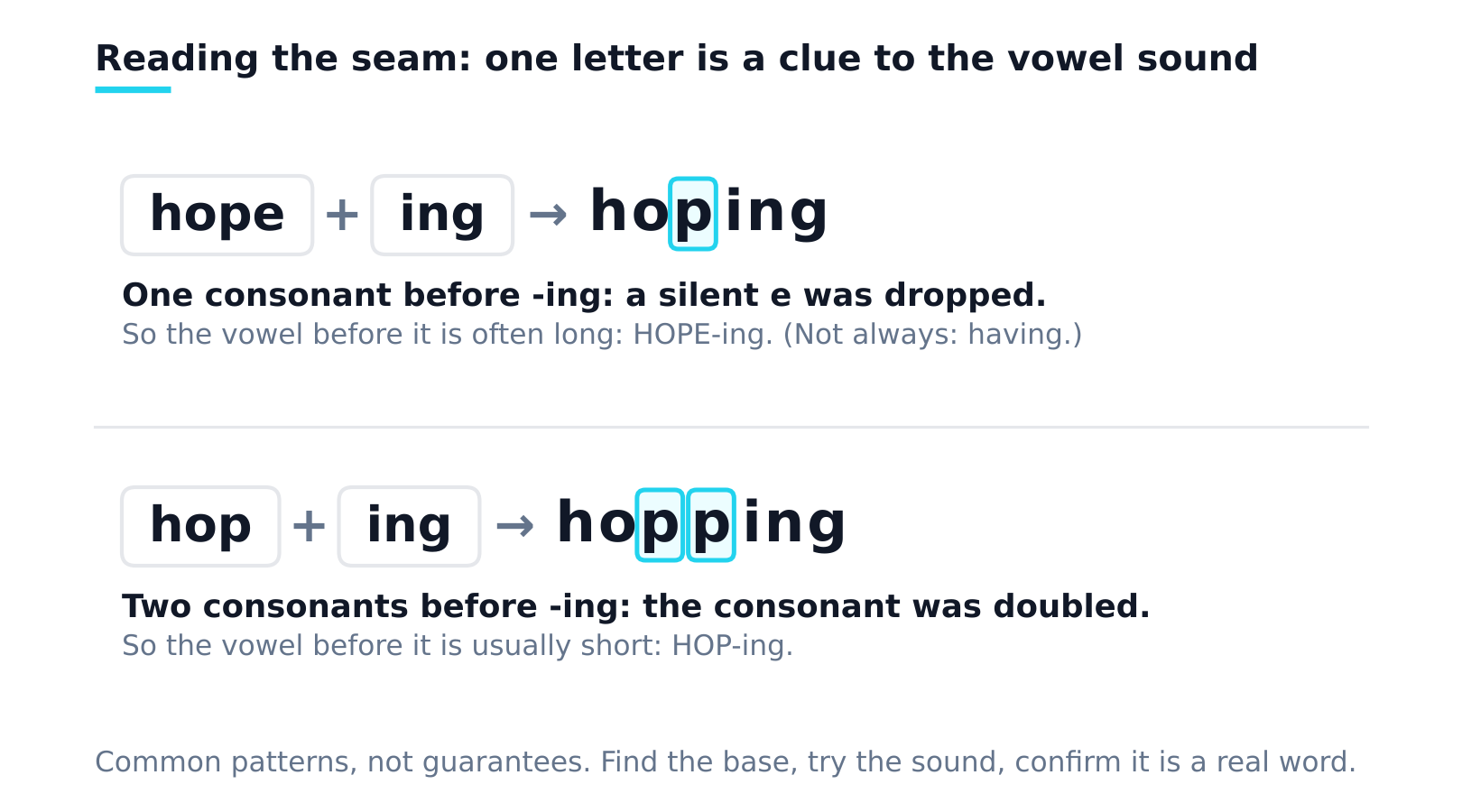
| One consonant, then -ing or -ed | A silent e was dropped, so the vowel is often long | hoping (hope), writing (write) |
| A doubled consonant, then -ing or -ed | The consonant was doubled, so the vowel is usually short | hopping (hop), planning (plan) |
| An i where you expected y | y changed to i, so read the base with its y | happiness (happy), carried (carry) |
These are common patterns, not guarantees: having comes from have, and its vowel is short. So teach the check that goes with them: find the base, try the sound, and confirm it makes a real word you know.
The first two rows are a matched pair worth teaching side by side. Hoping and hopping differ by one letter, and that letter is the only clue to the vowel sound. Older students who were never taught this have nothing to go on but a guess.
Common endings that help you read long words
Some word endings do not sound the way they look. Not all of them are suffixes in the strict sense: -ous is a true suffix, while endings like -cial and -cious are spelling patterns that include part of the base. For reading, what matters is that each one is a reliable chunk with a predictable sound. Teach them as whole chunks, sound first, so students never try to sound them out letter by letter.
| Ending | Says | Examples |
|---|---|---|
| -tion | /shun/ | action, nation, information |
| -sion | /zhun/ or /shun/ | vision, decision, tension |
| -ture | /cher/ | picture, nature, temperature |
| -cial, -tial | /shul/ | special, social, essential |
| -cious, -tious | /shus/ | delicious, precious, cautious |
| -ous | /us/ | famous, dangerous, enormous |
Suffixes that move the stress
Some suffixes pull the stress toward themselves, and the vowels in the base change sound to match. Say these pairs aloud and you will hear it:
- MAG-net, mag-NET-ic
- e-LEC-tric, e-lec-TRIC-i-ty
- ex-PLAIN, ex-pla-NA-tion
With -ic, -ity, and -tion, the stress usually lands on the syllable just before the ending. Students do not need to memorize every stress rule before attempting a long word. They do need to know that adding a suffix can change which syllable is stressed and how an unstressed vowel sounds. If the first try does not produce a familiar word, moving the stress is one useful fix. That is the Flex it step from the Flexible Strategy, and it is also why schwa and stress trip up so many older readers.
One prefix, four spellings
The prefix in-, meaning not, changes its last letter to fit the word it joins: im- before b, m, and p (impossible, immature), il- before l (illegal), and ir- before r (irregular). Same prefix, same meaning, four spellings. Teach them as a family, and the doubled letters in illegal and irregular stop looking like typos and start looking like clues.
Five mistakes to avoid
1. Teaching meanings without reading the words. A worksheet that matches pre- to "before" never asks the student to find pre- inside a long word and read it. Every word part lesson should end with students reading real words aloud.
2. Teaching too many roots at once. A list of 50 roots on a Monday is a memory test, not a reading tool. One part a day, practiced in real words and reviewed every few days, beats a big list every time.
3. Calling every letter string a prefix. The re in return is a prefix; the re in read is not. The test is whether a real base is left when you take it off. The Flexible Strategy covers this check.
4. Promising that the parts always give the meaning. Knowing the parts of a word does not always reveal its full meaning. Discover is not simply the opposite of cover. Teach word parts as a useful clue to meaning, not a guarantee.
5. Running it as a separate unit. For struggling readers, morphology showed its clearest results when it was part of their reading instruction (Goodwin and Ahn, 2010). Building a few minutes a day into your reading time, using words from your content, is a practical way to do that.
What to do tomorrow
- Pick one part. Choose a prefix from the starter list, or a root that shows up in your current unit. Un- is a safe first choice; so is any root in this week's reading.
- Make a list of six words that contain it, with the part in different spots, and include one long word from your content.
- Run the five moves: Say it, Spot it, Split it, Build it, Write it. Five minutes, whiteboards out.
- Watch one student. Pick the student you thought of when you read the opening. Notice whether the part jumps out for him by the end of the week.
That is the whole first lesson. You do not need a new curriculum or a root word workbook. You need one part a day and words that matter to your students.
If you are not sure yet which students need this work, start with the three quick checks in the complete guide to phonics intervention for middle and high school, or use Navigate, a free phonics screener that takes about 15 minutes.
Frequently asked questions
What is morphology in reading?
Morphology is the study of the meaningful parts inside words: prefixes, suffixes, and roots. For a student who stalls on long words, start with decoding: finding the part and reading it. Meaning can come along with it.
Does teaching prefixes and suffixes help struggling readers decode?
Teaching word parts can help students read and spell words, not only define them. The evidence is clearest for words students practice directly; carrying that skill to brand-new words in reading is less certain, so it has to be taught on purpose. A meta-analysis of 30 morphology studies with school-age students found significant effects on decoding and on spelling, along with vocabulary (Goodwin and Ahn, 2013).
Which prefixes should I teach first?
Among words that have a prefix, four prefix groups, un-, re-, in-/im-/il-/ir-, and dis-, account for more than half (White, Sowell, and Yanagihara, 1989). Un- alone covers about a quarter. Start there.
How much time does morphology instruction take?
One word part a day, five minutes, same five moves every time. The research does not set one ideal amount of time; this routine is a practical way to fit consistent practice inside your reading time.
References
- Archer, A. L., Gleason, M. M., & Vachon, V. (2006). REWARDS: Multisyllabic Word Reading Strategies. Sopris West. Book record
- Bowers, P. N., Kirby, J. R., & Deacon, S. H. (2010). The effects of morphological instruction on literacy skills: A systematic review of the literature. Review of Educational Research, 80(2), 144-179. doi.org/10.3102/0034654309359353
- Colenbrander, D., von Hagen, A., Kohnen, S., et al. (2024). The effects of morphological instruction on literacy outcomes for children in English-speaking countries: A systematic review and meta-analysis. Educational Psychology Review, 36, 119. doi.org/10.1007/s10648-024-09953-3
- Goodwin, A. P., & Ahn, S. (2010). A meta-analysis of morphological interventions: Effects on literacy achievement of children with literacy difficulties. Annals of Dyslexia, 60(2), 183-208. doi.org/10.1007/s11881-010-0041-x
- Goodwin, A. P., & Ahn, S. (2013). A meta-analysis of morphological interventions in English: Effects on literacy outcomes for school-age children. Scientific Studies of Reading, 17(4), 257-285. doi.org/10.1080/10888438.2012.689791
- Institute of Education Sciences, What Works Clearinghouse. (2022). Providing Reading Interventions for Students in Grades 4-9 (WWC 2022007). ies.ed.gov
- White, T. G., Sowell, J., & Yanagihara, A. (1989). Teaching elementary students to use word-part clues. The Reading Teacher, 42(4), 302-308. Prefix frequency table reproduced in ERIC ED483190.
By Genevra Self, Juniper Reading CoLab. Free to print and share with your team. juniperreadingcolab.com
https://www.juniperreadingcolab.com/articles/teach-prefixes-suffixes-roots-decoding