Around 2010, I walked into my school reading strategist's office and asked for help. My students' reading wasn't improving the way I wanted, and I didn't know what to change. She handed me the National Reading Panel report.
The report looked at five areas of reading instruction, and found evidence for teaching each of them:
| Area | What the National Reading Panel found |
|---|---|
| Phonemic awareness | Teaching children to work with the sounds in words was highly effective. |
| Phonics | Systematic phonics produced significant benefits for students in kindergarten through 6th grade, and for students with reading disabilities. |
| Fluency | Guided repeated oral reading improved word recognition, fluency, and comprehension. |
| Vocabulary | Vocabulary instruction led to gains in comprehension. |
| Comprehension | Explicit instruction in comprehension strategies was highly effective. |
I'd like to tell you I rebuilt my teaching around all five. I didn't. Like a lot of upper elementary teachers at the time, I believed phonemic awareness and phonics belonged in the primary grades, and that my job was the other three. So I rebuilt my reading instruction around fluency, vocabulary, and comprehension. It took me years, and a district phonics class, to see what that table had been telling me all along about phonics through 6th grade.
But one finding stuck with me from the start. Fluency was one of the high-yield practices, and it was connected to the thing I cared about most: whether my students understood what they read.
So I built a fluency routine, and I kept it in my classroom for more than a decade. It ran on a weekly cycle. Monday through Thursday, students worked with the same passage: they heard me model it, read it together as a class, practiced it alone with a whisper phone, which my students loved, upper grade students included, and read it to partners who gave them feedback. They set goals and tracked their own data. Every Friday I pulled each student for a one-on-one read of a new passage, and they graphed their growth.
It became one of my favorite routines, partly because it was an easy win for students at every level. My strongest readers didn't feel it was beneath them, and my struggling readers didn't feel it was out of reach. Everyone had a number, everyone had a goal, and everyone could watch that number move.
That last part is why fluency belongs in a series about older struggling readers. Most reading help for a teenager feels like a reminder of what they can't do. A fluency routine done well feels like training: a clear target, short practice, and proof on a graph that the practice is working.
What fluency is, and why it matters
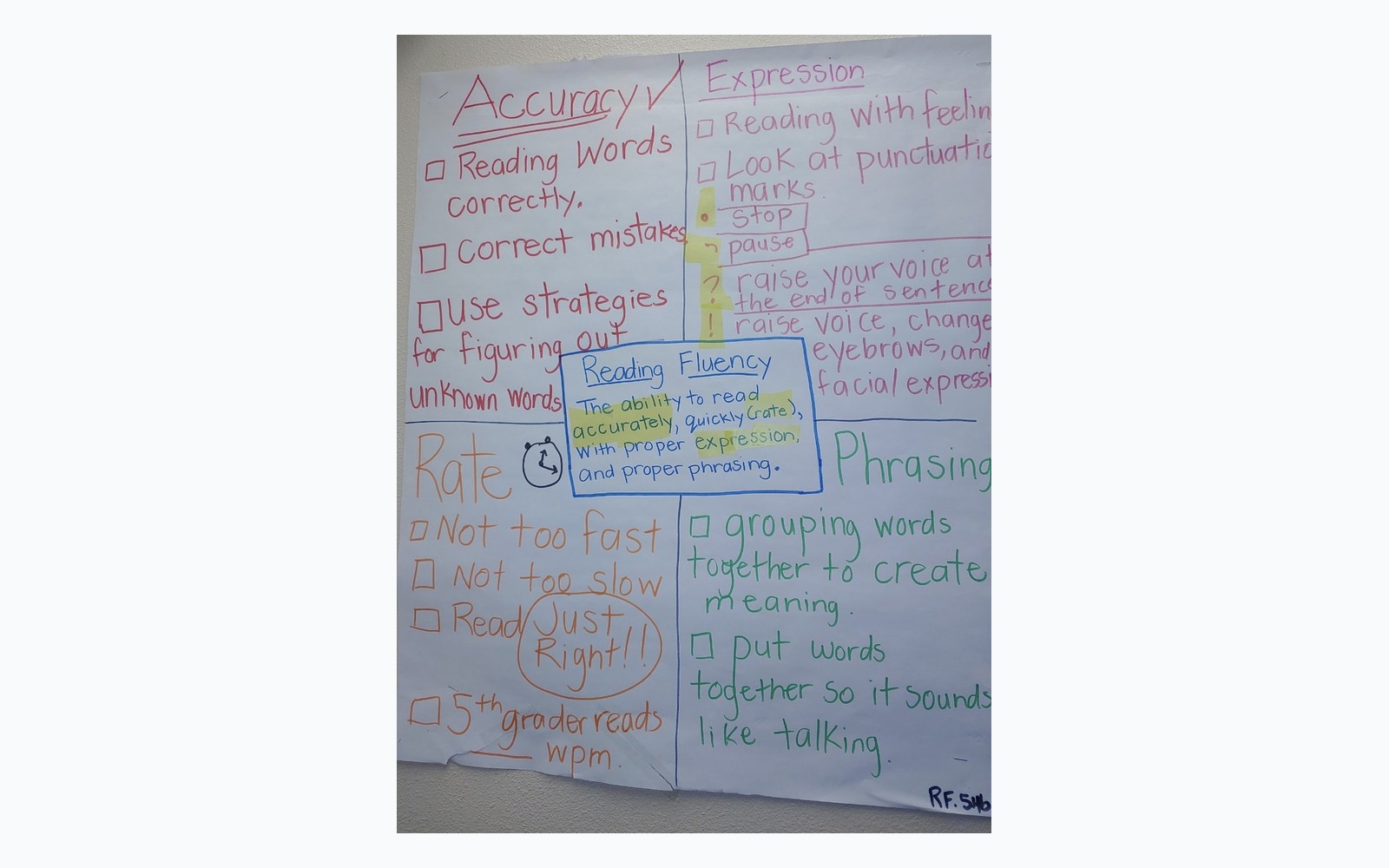
Reading fluency is the ability to read accurately, at a reasonable pace, with expression and natural phrasing. That's the definition at the center of my old anchor chart, and it still holds. It has four parts.
| Part | What it means | What you hear |
|---|---|---|
| Accuracy | Reading the words correctly | Few errors; mistakes get self-corrected |
| Rate | Not too fast, not too slow | A pace that sounds like a confident reader |
| Expression | Reading with feeling, using punctuation | Pauses at commas, stops at periods, a rising voice at questions |
| Phrasing | Grouping words into meaningful chunks | Sounds like talking, not like a list of words |
Why it matters for comprehension: attention is limited. A student who has to work on every word has little attention left for meaning. When word reading becomes automatic, that attention is freed up for understanding the text. Fluency is the bridge between reading the words and understanding them.
That's also why fluency is not the same as speed. A student who races through a passage in a flat voice, ignoring periods, is not fluent. Expression and phrasing are evidence that the reader is tracking meaning, not just words.
Why it works for older students at every level
Most reading interventions sort students in a way everyone can see. Fluency practice doesn't have to. Here is why it lands with teenagers.
- Everyone does the same work. Every student reads a passage, practices it, and tracks a number. The passage changes by level; the routine does not. Nobody is pulled out to do the "easy" version.
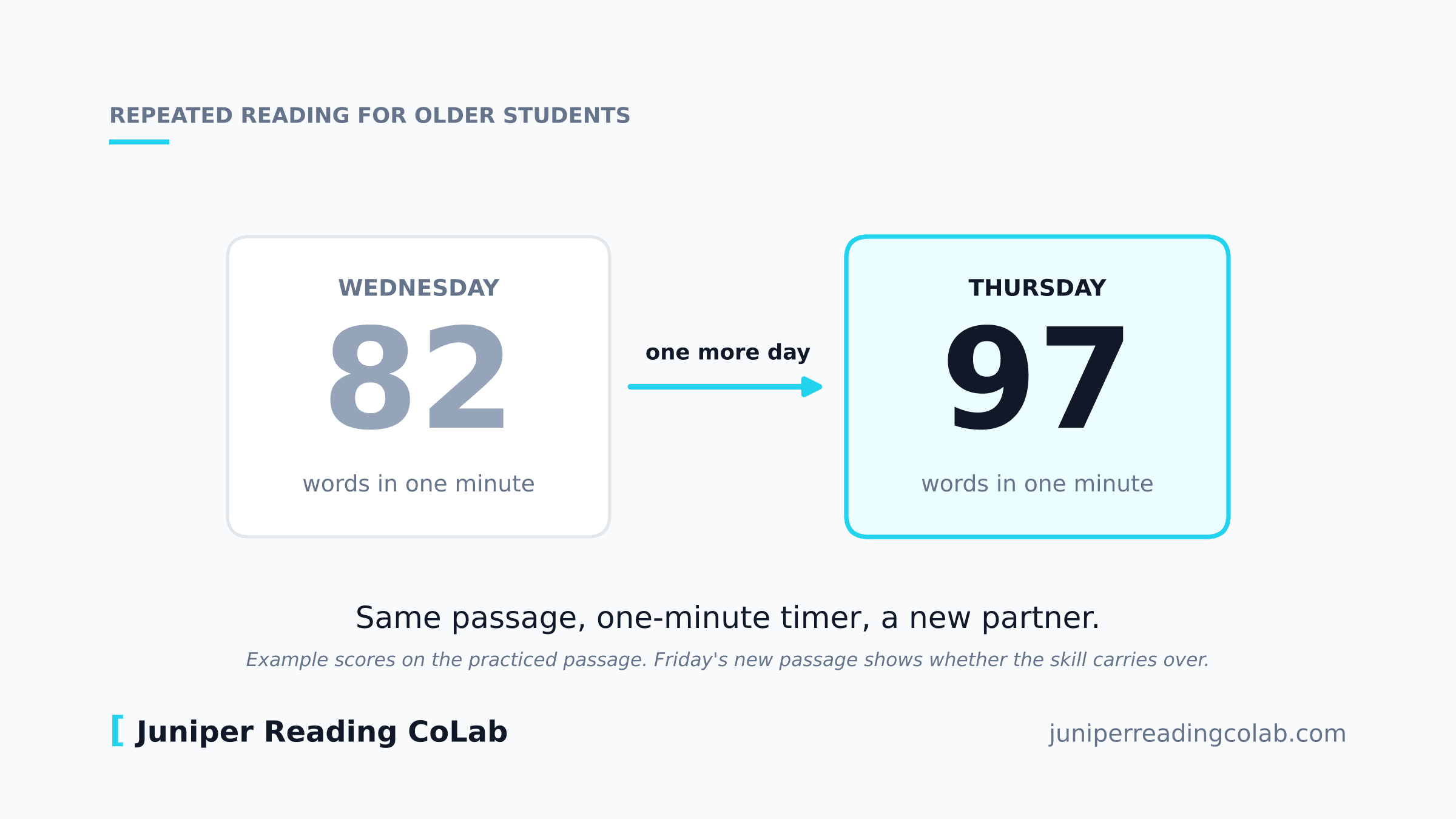
- The goal is personal. A student is not compared to the class. They are compared to their own last score. A struggling reader who goes from 82 to 97 words per minute gets the same win as a strong reader who goes from 140 to 152.
- Progress is visible fast. Within a single session, a student's second or third read is usually smoother than the first. That is evidence, in minutes, that practice pays off. For a student who has years of evidence that reading is hard, that is a big deal.
- It feels like training, not remediation. Timed attempts, a personal best, a graph going up: older students recognize this from sports, music, and games. It reads as a challenge, not a label.
This is the same dignity principle behind teaching phonics to older students without the babyish feel: keep the skill, change the packaging.
Check first: fluency problem or decoding problem?
Repeated reading helps a student who can read the words but reads them slowly or choppily. It does far less for a student who can't read the words in the first place. Practicing a passage you can't decode mostly teaches you to memorize it.
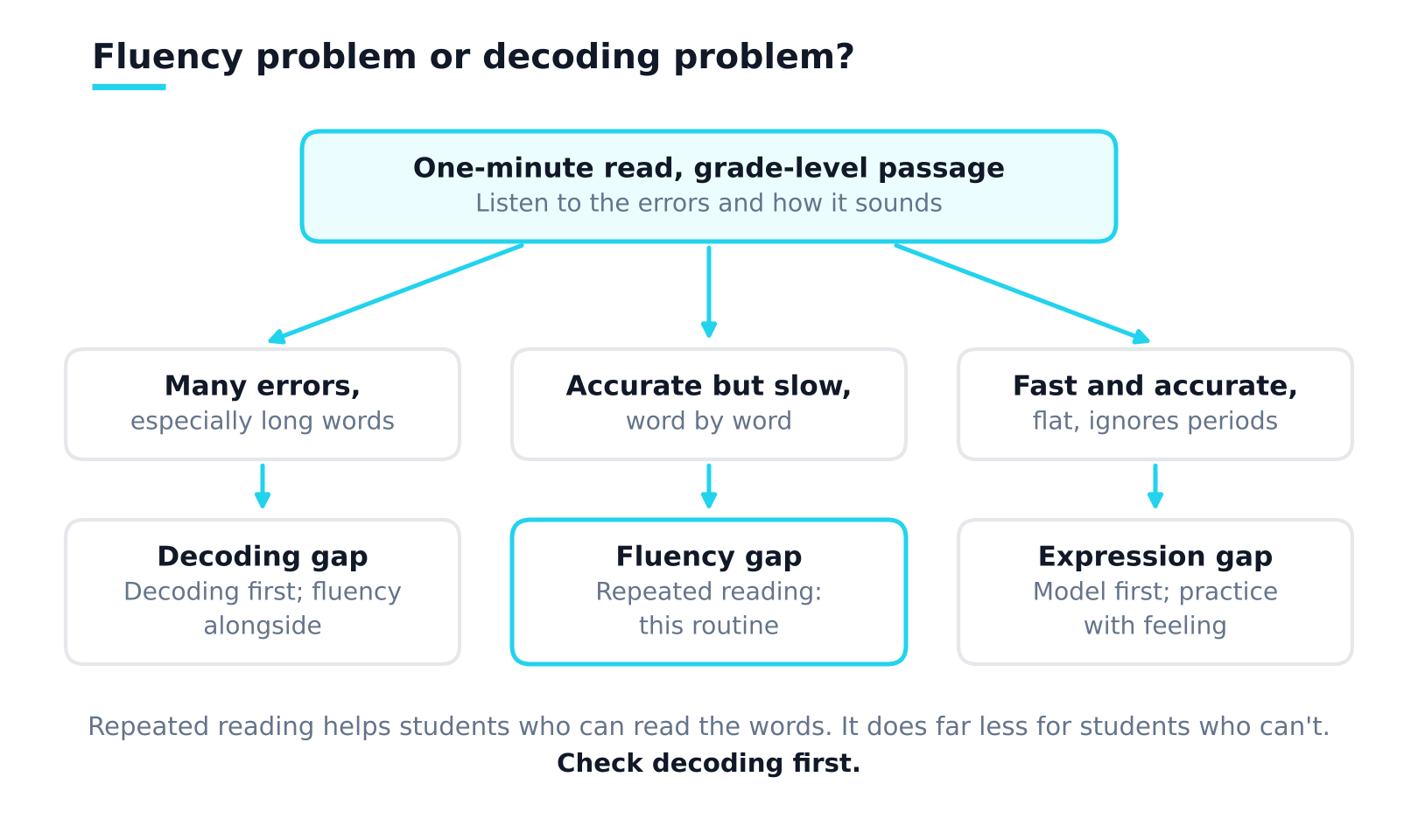
A quick first check: have the student read a short, grade-level passage aloud for one minute and listen to the errors. One reading won't tell you everything. Unfamiliar vocabulary, missing background knowledge, or complex sentences can slow a reader down too. Use it to decide what to look at next, not as a final answer.
| What you hear | What it likely means | Where to start |
|---|---|---|
| Accurate but slow, word by word | A fluency gap | Repeated reading, this routine |
| Many errors, especially on long words | A decoding gap | Decoding instruction first, fluency practice alongside |
| Accurate and fast, but flat and ignoring punctuation | A prosody gap | Modeling and repeated reading focused on expression |
For rate, a widely used reference is the Hasbrouck and Tindal oral reading fluency norms. A student reading 10 or more words correct per minute below the 50th percentile for their grade, averaged across two unpracticed grade-level readings, is a candidate for fluency work (Hasbrouck and Tindal, 2017). The 2017 norms run through grade 6, where the 50th percentile in spring is about 146 words correct per minute. For older students, treat that as a rough reference point, not a cutoff.
If you suspect a decoding gap, the three quick checks in the complete guide to phonics intervention for middle and high school will help you look closer, or you can use Navigate, a free phonics screener that takes about 15 minutes.
The weekly fluency routine
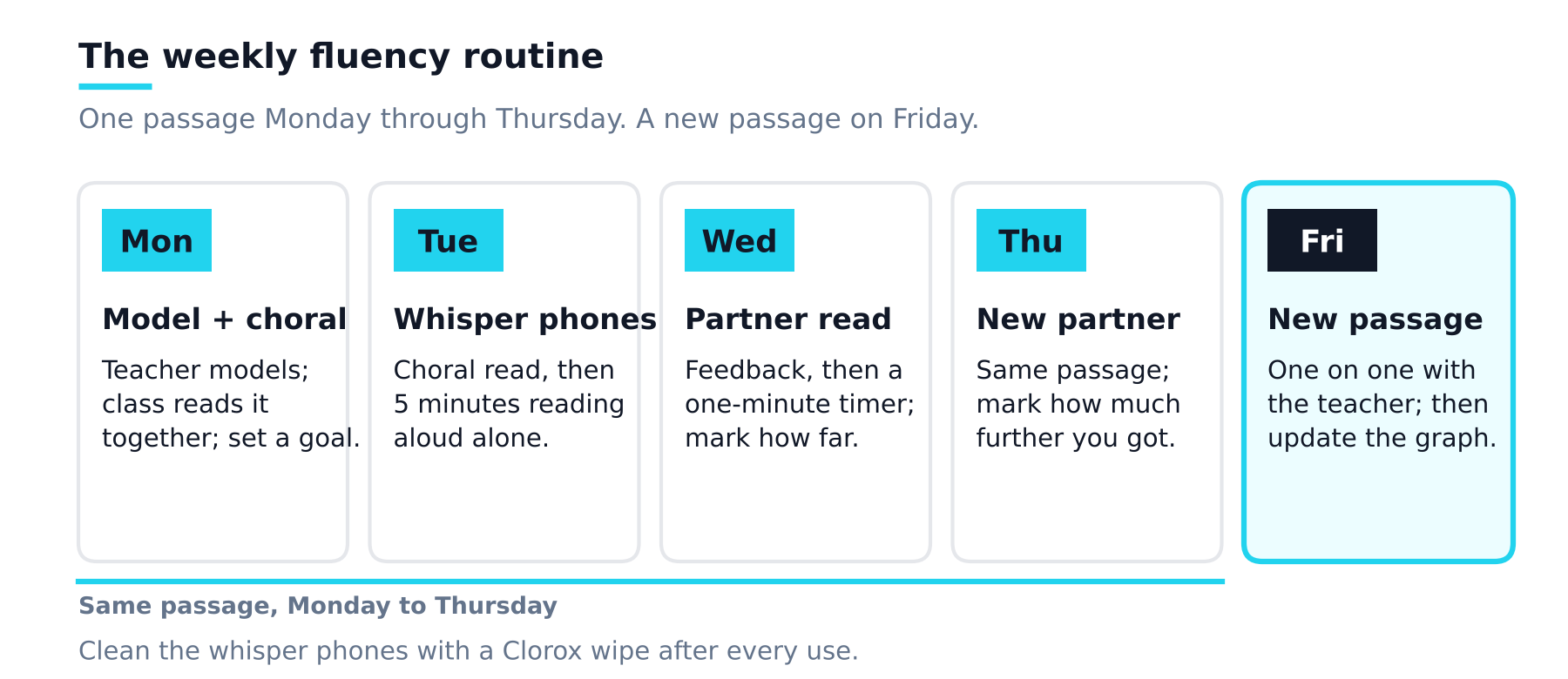
Repeated reading means reading the same short passage several times, with a model and feedback, until it sounds smooth. In my classroom it ran as a weekly cycle: the same passage Monday through Thursday, and a new passage on Friday.
| Day | What students do |
|---|---|
| Monday | Hear the teacher model the passage, choral read it as a class, set a goal |
| Tuesday | Choral read, then five minutes of whisper phone practice anywhere in the room |
| Wednesday | Partner read with feedback; mark how far they get in one minute |
| Thursday | New partner, read with feedback; mark how much further they get in one minute |
| Friday | New passage, one on one with the teacher; mark the weekly fluency graph |
If you want the whole week on one page, the printable plan has the day-by-day steps, the materials, how to score the Friday read, and a Friday class record.
Partner Repeated Reading: The Weekly Plan (printable) (PDF, 48 KB)
Monday: model, choral read, set a goal
I read the passage aloud with expression while students followed along. That model matters: in a review of fluency studies with older struggling readers, gains were most consistent when students heard a fluent model before reading on their own (Wexler and colleagues, 2008). Then we read it together as a class. Choral reading gives every student a safe first pass, with the whole class carrying the hard words. Then each student set a goal for the week.
Tuesday: choral read, then whisper phones
We choral read the passage again as a class. Then students grabbed a whisper phone and read the passage aloud by themselves for five minutes, anywhere in the classroom. My students loved using them, upper grade students included.
A whisper phone is a curved plastic tube, shaped like an old telephone handset, that carries a student's voice from their mouth straight back to their ear. Why it earns a place in fluency practice:
- Every student reads aloud at once. The whole class can practice at the same time without the room getting loud, so every student gets real reading-aloud time instead of waiting for a turn.
- Students hear themselves clearly. Reading in a whisper, a student can hear their own pace, their pauses, and where their voice goes flat. That makes expression and phrasing something they can notice and fix on their own.
- No audience. The only listener is the reader. For a student who dreads reading aloud, that is a low-risk way to practice before reading to a partner.
One non-negotiable: clean them. Every student wipes down their whisper phone with a Clorox wipe when they finish, every time. Build it into the routine so it is automatic, the same way students put away materials. Whisper phones are inexpensive to buy, and you can also make them from PVC pipe elbows from a hardware store.
Wednesday: partner read and feedback
Students partner up. One partner reads while the other follows along on their own copy. The listener gives feedback tied to the four parts on the anchor chart: "You stopped at the period that time," or "Try grouping 'in the middle of the night' together." One specific comment beats a general "good job." Then the reader reads for one minute on a timer, and they mark how far they got. Partners switch roles.
Print the partner feedback card so every listener has the steps and the feedback starters in front of them.
Partner Feedback Card (printable, two per page) (PDF, 65 KB)
Thursday: a new partner
Same routine, different partner. A fresh listener hears the passage new and gives new feedback. With the one-minute timer, each reader marks how much further they got than on Wednesday. After three days with the same passage, that jump is usually there, and students can see it on the page.
Friday: a new passage, one on one
On Friday the passage changes. I pulled each student for a one-on-one read of a new passage and they marked the result on their weekly fluency graph. The new passage is the point: gains on a passage you have practiced all week are expected. Gains on text you have never seen show the skill is growing.
Choosing the passage
Use text the student can read with about 95 percent accuracy on the cold read. Harder than that and practice turns into decoding work; easier and there is no room to grow. Short nonfiction from your content area works well, and it doubles as background knowledge for your unit.
Goals, graphs, and the Friday check
The practice builds the skill. The data keeps students coming back to it.
Set a goal every Monday. Each student sets a target for the week. A goal they can reach in a few weeks works better than a distant benchmark.
Mark the partner days. On Wednesday and Thursday, students mark how far they got in one minute. Seeing Thursday beat Wednesday on the same passage is the quick, visible win that keeps students engaged.
Graph the Friday read. The Friday score on a new passage goes on the weekly fluency graph. This is the number that matters most, because it shows whether gains carry over to text the student has never practiced. The read itself takes one minute per student. Score it as words correct per minute: the total words read minus the errors. Keep the Friday passages at about the same difficulty from week to week, so the scores can be compared. A harder passage can pull a score down even when the student is improving.
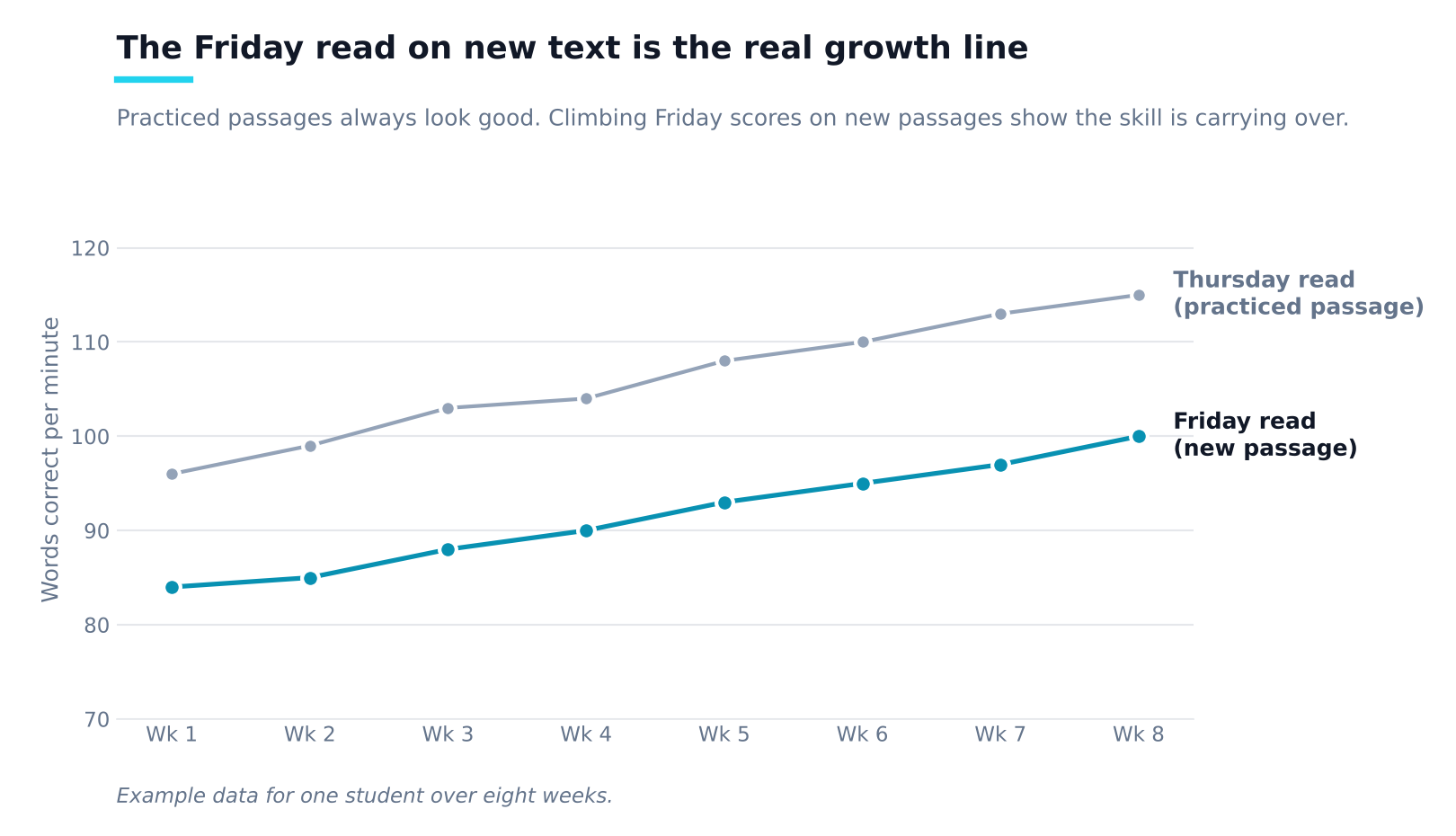
There are two printable trackers, so you can pick the one that fits your students. The graph has students plot a dot each Friday and connect them. The scorecard has one row per week with no graphing.
My Fluency Graph (printable) (PDF, 58 KB)
My Fluency Scorecard (printable) (PDF, 43 KB)
Let students read their own data. Ask students to look at their graph and tell you what they notice. A student who can say "my cold reads went up 15 words since September" has ownership of their reading that no pep talk can give them.
What the research says
The short version: fluency practice works, especially for building reading speed and accuracy, but with older students the gains don't automatically turn into better comprehension. That shapes how you should run it.
- The original case. The National Reading Panel (2000) named fluency one of five essential components of reading instruction and found that guided repeated oral reading, with feedback from teachers, peers, or parents, improved word recognition, fluency, and comprehension across a range of grade levels.
- Repeated reading works for struggling readers. A meta-analysis of 18 studies with students ages 5 to 18 found repeated reading improved both fluency and comprehension, including for students with learning disabilities (Therrien, 2004).
- Older students: fluency yes, comprehension less consistently. A review of 19 fluency intervention studies with struggling readers in grades 6 to 12 found fluency gains were most consistent when students heard a fluent model before practicing. Evidence that repeated reading improves comprehension was less consistent. There was also early evidence that reading the same amount of new, non-repeated text may work about as well (Wexler and colleagues, 2008).
- It's a federal recommendation. The Institute of Education Sciences practice guide for grades 4 to 9 gives a strong evidence rating to providing purposeful fluency-building activities to help students read effortlessly (IES, 2022). That rating covers fluency-building activities in general, not one specific routine like this one.
What this means for your classroom:
- Model first and give feedback. Those two pieces show up again and again in the routines that work.
- Check on new text. Gains on a practiced passage are expected. The Friday read on an unpracticed passage tells you whether the skill is carrying over.
- Don't make it the only reading. Repeated reading builds speed; reading lots of new text builds everything else. Use the routine alongside plenty of reading in new material, not instead of it.
- Fluency is necessary, not sufficient. It frees attention for comprehension. It doesn't teach comprehension on its own.
Five mistakes to avoid
1. Treating fluency as speed. If the only number students chase is words per minute, they learn to race and ignore punctuation. Score expression every time, and celebrate a read that sounds like talking, not just a fast one.
2. Round-robin reading. Calling on students to read aloud one at a time in front of the class is not fluency practice. Each student reads a few sentences, cold, in public, while everyone else waits. Partner practice gives every student far more reading time with far less exposure.
3. Text that's too hard. If a student makes more than a few errors per hundred words on the cold read, the passage is too hard for fluency practice. Drop the level. Fluency is built on text students can already decode.
4. Skipping the decoding check. A student who stumbles on long words needs decoding instruction, not more timed reads. Fluency practice alongside decoding work is fine. Fluency practice instead of it is not.
5. Only ever measuring the practiced passage. Reads on a passage students have practiced all week will always look good. Without a regular read on new text, you can't tell whether a student is growing or just memorizing.
What to do tomorrow
- Pick one passage for the week, about 150 to 250 words, from something your students are already reading.
- On Monday, model it and choral read it, then have each student set a goal for the week.
- Have whisper phones and Clorox wipes ready for Tuesday.
- Before Wednesday, teach the listener's job: follow along, give one specific comment, run the one-minute timer, mark how far the reader got.
- Pick a new passage for Friday and give each student a simple graph for their one-on-one score.
The first week will feel clunky. By the second, most students know the cycle, and you are free to listen in and coach.
If your students also stall on long words, check for a decoding gap first, then pair this routine with the Flexible Strategy for big-word decoding. Decoding gets the words right; fluency makes them automatic.
Frequently asked questions
What is reading fluency?
Reading fluency is the ability to read accurately, at a reasonable pace, with expression and natural phrasing. Fluency is the bridge between reading the words and understanding them.
What is repeated reading?
Repeated reading means reading the same short passage several times, with a model and feedback, until it sounds smooth. In my classroom it ran as a weekly cycle: the same passage Monday through Thursday, and a new passage on Friday.
Does repeated reading improve comprehension for older students?
A review of 19 fluency intervention studies with struggling readers in grades 6 to 12 found fluency gains were most consistent when students heard a fluent model before practicing. Evidence that repeated reading improves comprehension was less consistent. Repeated reading builds speed; reading lots of new text builds everything else.
How do I know if a student has a fluency problem or a decoding problem?
A quick first check: have the student read a short, grade-level passage aloud for one minute and listen to the errors. Use it to decide what to look at next, not as a final answer. Repeated reading helps a student who can read the words but reads them slowly or choppily. It does far less for a student who can't read the words in the first place.
What level of text should students use for fluency practice?
Use text the student can read with about 95 percent accuracy on the cold read. Harder than that and practice turns into decoding work; easier and there is no room to grow.
References
- Hasbrouck, J., & Tindal, G. (2017). An update to compiled ORF norms (Technical Report No. 1702). Behavioral Research and Teaching, University of Oregon. Norms chart via Reading Rockets
- Institute of Education Sciences, What Works Clearinghouse. (2022). Providing Reading Interventions for Students in Grades 4-9 (WWC 2022007). ies.ed.gov
- National Reading Panel. (2000). Teaching children to read: An evidence-based assessment of the scientific research literature on reading and its implications for reading instruction. National Institute of Child Health and Human Development. nichd.nih.gov
- Therrien, W. J. (2004). Fluency and comprehension gains as a result of repeated reading: A meta-analysis. Remedial and Special Education, 25(4), 252-261.
- Wexler, J., Vaughn, S., Edmonds, M., & Reutebuch, C. K. (2008). A synthesis of fluency interventions for secondary struggling readers. Reading and Writing, 21(4), 317-347. doi.org/10.1007/s11145-007-9085-7
By Genevra Self, Juniper Reading CoLab. Free to print and share with your team. juniperreadingcolab.com
https://www.juniperreadingcolab.com/articles/repeated-reading-fluency-middle-high-school